
Why Your Supply Chain Data Is 2026's Most Undervalued Commercial Asset
Data Commercialisation | Logistics and Supply Chain | 8 min read | April 2026
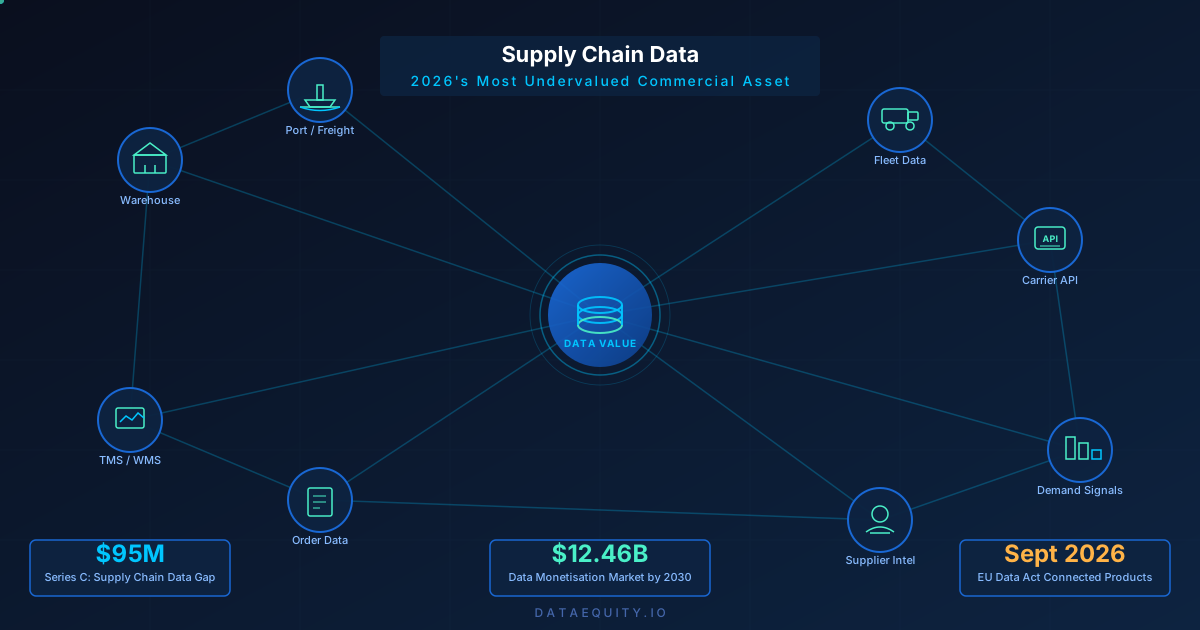
When Loop, the US logistics AI company backed by Valor Equity Partners, Founders Fund, Index Ventures, and J.P. Morgan Growth Equity Partners, announced a $95 million Series C this week, most coverage filed it as routine venture activity. Strip away the headline and the problem statement behind the round is considerably more instructive: supply chains remain, as Loop's investors stated plainly, "one of the hardest environments for AI deployment because the underlying data is inconsistent, inaccessible, and spread across disconnected enterprise systems." The company has now raised a total of $210 million not primarily to build AI capability, but to solve a structural data problem. Its proprietary DUX foundation model achieves over 99 per cent touchless automation specifically by normalising freight data that organisations already generate and already hold. The data exists. It has never been commercially valued. And for the carriers, logistics operators, retailers managing their own distribution, and manufacturers overseeing inbound supply chains generating this data daily, that gap between operational possession and commercial value is precisely where the most significant untapped asset on their balance sheet sits.
The commercial market forming around these organisations is already active, whether or not those organisations have noticed. AI developers, commercial insurers, financial analysts, urban infrastructure planners, and procurement intelligence platforms are actively seeking access to proprietary logistics datasets. Carrier performance benchmarks, transit time distributions, demand signal patterns, route optimisation data, and supplier reliability indices are among the most commercially sought-after inputs in the current data market. The global data monetisation market is projected to grow from $4.78 billion in 2025 to $12.46 billion by 2030, at a compound annual growth rate of over 21 per cent. Supply chain and operational logistics data is a material contributor to that trajectory. The organisations that move first to formally value and position their data assets will not simply generate additional revenue; they will arrive at a more accurate picture of what their enterprise is actually worth.
Key Takeaways
- Loop's $95 million Series C in April 2026, taking total funding to $210 million, signals that top-tier investors are placing institutional capital against the supply chain data gap alone, confirming that demand from data buyers is established and growing at scale.
- The global data monetisation market is forecast to reach $12.46 billion by 2030 at over 21 per cent CAGR, with operational and proprietary datasets commanding premium valuations among AI developers and commercial analytics providers.
- McKinsey research confirms that enterprises treating data as a strategic asset generate 40 per cent more revenue than their peers, yet the vast majority of logistics data never leaves the TMS, WMS, or ERP system in which it was first created.
- The EU Data Act requires that from September 12, 2026, all new connected products placed on the EU market must enable direct, machine-readable data access under FRAND conditions, placing formal governance obligations on logistics operators running connected fleet and warehouse infrastructure.
- The API economy reached $16.29 billion in 2026, growing annually, with logistics data APIs among the fastest-growing product categories for commercial data exchange; fewer than one in five logistics operators has structured a single dataset as a market-facing product.
- DataEquity's DataVault platform enables logistics and supply chain organisations to discover, assess, and formally value their proprietary data assets across all operational systems, producing a Data Equity Score and Market Readiness Score without a single byte leaving the business.
Why 2026 Is the Inflection Point for Supply Chain Data
The Loop funding round is one data point, but it is a precise one. Investors with full access to market diligence placed $95 million against the thesis that supply chain data is structurally underexploited and that a business model built on normalising, structuring, and activating it can justify nine figures of institutional capital. That conviction is not isolated; three regulatory and commercial forces have converged this year in ways that create conditions that did not exist twelve months ago.
The first is buyer urgency. AI model developers and commercial analytics providers are seeking high-quality proprietary operational datasets to improve the domain specificity of their intelligence products, and logistics data, with its density of real-world decision variables, commands a premium in this market. The second is regulatory formalisation. The EU Data Act's connected-products obligations, taking effect from September 2026, require logistics operators running IoT-enabled fleet, warehouse, and infrastructure assets across the EU market to architect data access as a formal governance requirement. This is no longer a strategic option; it is a five-month compliance window. The third is competitive urgency: as data intermediaries normalise and package logistics intelligence for external sale, operators risk having their own operational data commoditised by third parties unless they establish independent data products and pricing power first.
For organisations that act now, the reward is first-mover pricing advantage in a market where buyer demand is demonstrably real and seller supply remains constrained. For those that wait, the risk is that pricing power migrates permanently to intermediaries.
What Your Logistics Data Is Actually Worth, and Why Most Organisations Do Not Know
The first problem facing most logistics organisations is not commercialisation; it is valuation. Before any data can be sold, licensed, or offered through a marketplace, the organisation must understand what it holds: what exists, where it lives, how complete and consistent it is, who holds the rights to it, and what a credible external buyer would pay for access. Most large organisations have no formal answer to any of these questions, not because the data is unavailable but because it has never been assessed through a commercial lens.
The Commercially Valuable Categories
The range of commercially exploitable supply chain data assets is considerably broader than most data teams assume. Carrier performance data, including historical on-time rates, damage frequencies, and cost benchmarks by lane and season, commands consistent demand from insurance underwriters, commercial lenders, and freight procurement platforms. Route intelligence and transit time distributions are monetisable by logistics aggregators, urban infrastructure investors, and e-commerce operators managing customer-facing delivery promises. Demand signal data, derived from order management and inventory systems, is among the most sought-after inputs for retail category forecasting models and financial analysts covering consumer sectors. Supplier reliability indices, built from years of inbound procurement records, are used by risk analytics providers, trade finance institutions, and procurement intelligence platforms.
McKinsey's finding that organisations treating data as a strategic asset generate 40 per cent more revenue than competitors reflects a simple shift in perspective: from data as operational exhaust to data as a managed asset with measurable commercial value. The analytical step required to close that gap is a formal valuation methodology, not a technology transformation. DataEquity's DataVault platform applies a five-lens assessment across operational, governance, commercial, technical, and regulatory dimensions to produce a Data Equity Score and Market Readiness Score for each dataset in scope.
From Operational Records to Commercial Data Product
The language gap between data holder and data buyer is not trivial. Logistics organisations describe their data in operational terms: shipment records, carrier invoices, route logs, warehouse throughputs. Buyers describe the same data in commercial terms: transit intelligence, carrier benchmarks, network efficiency metrics, demand signals. Closing that gap requires a structured sequence of product decisions that goes well beyond data export.
Building a commercial data product from operational supply chain data requires answers to questions that most engineering teams are not positioned to address alone. What is the coverage and completeness of the dataset? What is its update frequency and latency? What contractual rights does the organisation hold over data produced by third-party carriers or warehouse management system providers? What anonymisation or aggregation is required before external exposure? What commercial model, whether subscription access, event-based licensing, or usage-tiered API delivery, best reflects the value delivered to the buyer?
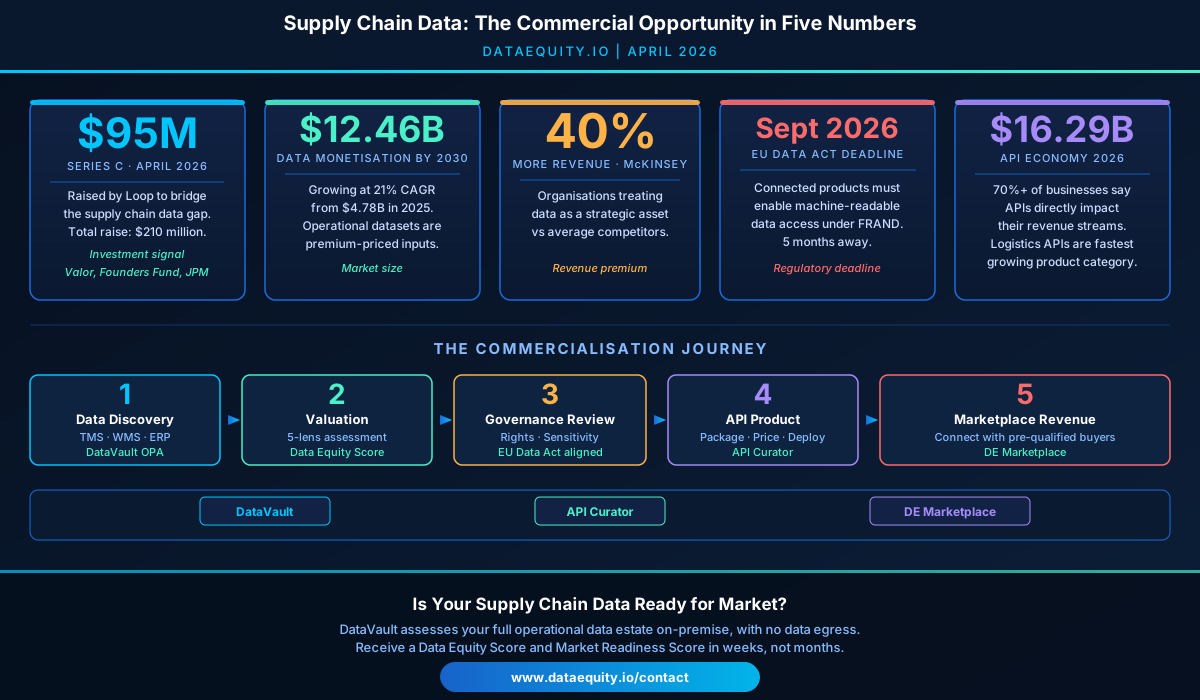
These decisions require coordinated input from legal, commercial, data engineering, and compliance functions working against a shared governance framework. Organisations that get this right treat each dataset as a product, with a product owner, a defined customer segment, a documented pricing rationale, and a roadmap for ongoing enhancement.
The API Opportunity: Structuring Logistics Intelligence for Commercial Delivery
The primary commercial interface for proprietary logistics data is the API, and the economics are substantial. The API economy reached $16.29 billion in 2026, growing annually at a rate that reflects a fundamental shift in how data is consumed across industries. More than 70 per cent of businesses report that APIs directly impact their revenue streams. For logistics data specifically, the API model offers structural advantages: the data holder maintains full governance and access control, consumption is metered precisely, and pricing can be calibrated to the granularity of the insight delivered.
The categories of logistics API that attract consistent commercial demand include carrier scoring APIs, consumed by shipper platforms and freight procurement systems; transit time prediction APIs, consumed by e-commerce platforms managing customer-facing delivery promises; demand signal feeds, consumed by financial analytics platforms and retail category managers; and network density APIs, consumed by infrastructure investors and urban mobility planners. Organisations holding years of operational data in any of these categories have viable commercial API products available to them, provided they have the governance, documentation, and pricing infrastructure to deploy them.
DataEquity's API Curator product addresses the four elements that most internal API initiatives fail on: the commercial packaging, the developer experience, the governance controls, and the pricing model that converts a proprietary data feed into a sustainable, scalable revenue line.
Governance, Sovereignty, and the September 2026 Deadline
Supply chain data carries competitive sensitivity that many other commercial datasets do not. Carrier rates, route costs, supplier terms, and network configurations represent sources of operational advantage that organisations must protect rigorously. Any commercialisation programme must begin with a governance framework that distinguishes between data that can be safely monetised and data that must remain proprietary.
The September 2026 EU Data Act deadline makes this distinction a legal obligation, not merely a best practice. From September 12, 2026, any connected product or service placed on the EU market must enable users to access their data directly, in a structured and machine-readable format, under FRAND conditions. For logistics operators running IoT-enabled fleet, smart warehouse infrastructure, or connected logistics platforms, this means that governance over what data is held, how it was generated, and under what terms it can be shared must be formally documented within the current operating year.
The technical implication is equally specific: data discovery and valuation cannot require data to leave the organisation's own infrastructure. External processing creates both a security exposure and a contractual complexity, particularly where data involves information from supplier or carrier relationships that carry their own confidentiality terms. DataEquity's DataVault is built around an On-Premise Assessment Agent that conducts the full discovery and valuation process within the organisation's own environment, producing a Data Equity Score without any data egress, and satisfying both the competitive sensitivity concern and the regulatory requirement for purposeful, documented data governance.
Frequently Asked Questions
What is supply chain data monetisation and why does it matter now?
Supply chain data monetisation is the process of converting proprietary operational data, generated through logistics, warehouse, procurement, and carrier management activities, into a commercially valuable asset that generates revenue, enables licensing arrangements, or supports strategic data partnerships. It matters now because three forces have converged simultaneously: institutional investor demand confirmed by Loop's $95 million raise; active buying intent from AI developers and analytics providers seeking domain-specific operational datasets; and the EU Data Act's September 2026 deadline, which makes formal data governance a compliance requirement. Organisations that build valuation and governance capability now will commercialise from a position of control, rather than reactive compliance.
How do we handle competitive sensitivity when commercialising logistics data?
Most commercial data products derived from supply chain operations are abstracted from raw records before they reach a buyer. Aggregated carrier benchmarks, anonymised transit distributions, and demand signal patterns are commercially valuable without exposing the rate agreements, route configurations, or supplier terms that represent genuine competitive advantage. The appropriate starting point is a data classification exercise that maps each asset against its commercial sensitivity and identifies what can be safely monetised at which level of abstraction. DataVault's five-lens assessment framework covers the rights and governance dimension as an integral part of the valuation process, ensuring that commercial decisions are informed by a full understanding of competitive and contractual constraints.
What does the EU Data Act mean for logistics operators specifically?
For logistics operators with connected fleet, warehouse, and IoT infrastructure in the EU market, the EU Data Act creates two distinct obligations from September 2026. First, an access obligation: users of connected products must be able to access their data directly, in a structured and machine-readable format, at no charge. Second, a sharing obligation: under fair, reasonable, and non-discriminatory conditions, data holders can be required to share data with authorised third parties. Both obligations presuppose a formal data register that documents what data is held, by whom it was generated, and under what terms it can be shared. Organisations that have already completed a structured data discovery exercise will find compliance considerably more straightforward than those that have not.
What return on investment can a logistics organisation realistically expect?
Early-stage returns depend on the uniqueness, coverage, and quality of the datasets in question. Organisations with national or international network coverage and high-frequency operational data are in a stronger commercial position than regional operators with thinner datasets. Initial API licensing agreements for carrier performance benchmarks or demand signal feeds from mid-sized operators typically generate low six-figure annual revenues. The larger opportunity lies in strategic licensing arrangements with AI model developers and financial analytics providers, where proprietary datasets with multi-year depth and demonstrated predictive accuracy command substantially higher valuations. A formal DataVault assessment provides the defensible price floor required before any commercial negotiation begins.
Do we need to replace our existing technology infrastructure to start?
No. The most common misconception about data commercialisation is that it requires a wholesale technology transformation before any commercial activity can begin. The discovery and valuation phase, which is the logical starting point, operates against existing systems without requiring data migration, replatforming, or significant engineering investment. DataVault deploys an on-premise agent that connects to existing TMS, WMS, ERP, order management, and carrier integration systems, conducting the full assessment within the organisation's own environment. The output is a Data Equity Score and Market Readiness Score that informs a board-level decision about which data assets to prioritise and what incremental investment, if any, is required to take them to market.
What is DataVault and how does it help logistics organisations value their data?
DataVault is DataEquity's on-premise data discovery and valuation platform, designed for any organisation holding substantial proprietary operational data. For logistics and supply chain organisations, it deploys an On-Premise Assessment Agent across all connected operational systems, applying a five-lens framework covering operational quality, governance maturity, commercial potential, technical readiness, and regulatory posture. The output is a Data Equity Score and Market Readiness Score for each dataset reviewed, providing a quantified basis for commercialisation decisions and a clear roadmap for improving the market readiness of priority assets. The entire process runs within the organisation's own infrastructure; no data leaves the business and no competitive information is exposed during the assessment.
Your supply chain data is already being targeted by intermediaries and AI developers. DataEquity's DataVault platform gives you the formal discovery and valuation capability to understand what you hold, what it is worth, and how to commercialise it on your terms and within your infrastructure. Contact us at https://www.dataequity.io/contact to arrange a confidential on-premise assessment.