
Why MHHS Is Creating the UK Energy Sector's Most Valuable Untapped Asset
Energy & Utilities | 9 min read | April 2026
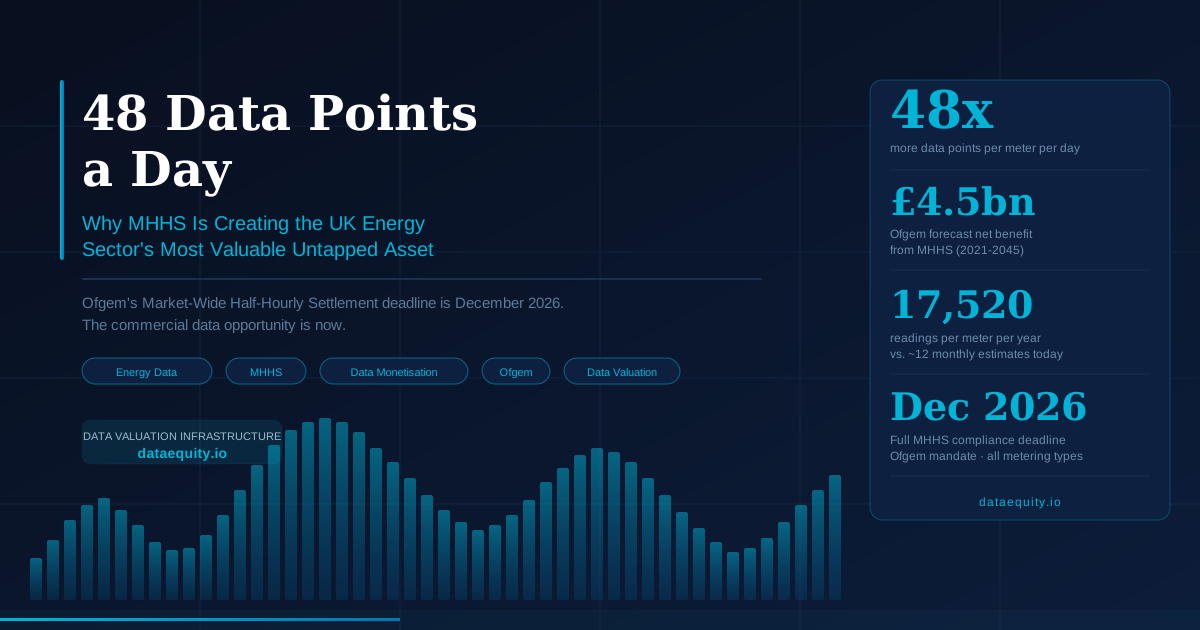
From December 2026, every electricity meter in the UK must submit consumption data to Ofgem every thirty minutes. That is 48 readings per meter, per day - a volume of structured, site-level data that dwarfs anything most energy companies have ever systematically managed. Ofgem's Market-Wide Half-Hourly Settlement (MHHS) programme has been widely described as the most significant electricity market reform since competition was introduced in 1998, yet almost every commercial discussion of it centres on operational compliance: systems integration, billing migration, and settlement code obligations. That framing is leaving considerable value on the table. The organisations that extract the most long-term benefit from MHHS will not necessarily be those that complete compliance fastest. They will be the ones that recognise what compliance creates: a structured, high-frequency, site-level proprietary dataset with a buyer market that already exists and is growing.
The habit of treating regulatory data as an audit trail rather than a commercial asset is widespread in regulated industries, but it is particularly consequential in energy. MHHS will generate, for the first time, a consistent and continuous national dataset of granular electricity consumption: time-stamped, site-specific, and structured at a regularity that enables real statistical depth. For energy suppliers, distribution network operators, demand-side response aggregators, and large industrial consumers, this is not simply a record of billing events. It is a proprietary signal that underpins grid balancing, demand forecasting, carbon reporting, asset optimisation, and commercial benchmarking across dozens of adjacent markets. The demand for this signal already exists. What most organisations lack is the framework to discover what they hold, understand its market value, and build the governance necessary to act on it.
Key Takeaways
- Ofgem predicts net consumer benefits of £1.6bn to £4.5bn from MHHS over the period 2021 to 2045. This estimate captures billing efficiency and demand flexibility but does not assign any value to the commercial data asset being created.
- From December 2026, all metering types in the UK must submit half-hourly data to Ofgem. Full electricity market trading on half-hourly data is targeted from October 2026, with migration having begun in September 2025.
- Under MHHS, each meter will generate 17,520 readings per year compared to the handful of estimated or actual readings used for settlement today - a structural change in data volume, not an incremental one.
- The vast majority of UK energy organisations currently have no formal data asset register, no structured valuation methodology, and no commercially oriented data strategy aligned to their MHHS readiness programme.
- Enterprises with formal commercial data strategies report revenue uplifts of 25% through third-party data integrations; energy companies holding well-governed half-hourly consumption profiles are within reach of comparable outcomes.
- DataEquity's DataVault platform enables energy companies to discover, classify, and score their MHHS-generated datasets entirely within their own infrastructure - producing a Data Equity Score and Market Readiness Score before the December 2026 deadline, with no data leaving the organisation's environment.
What MHHS Actually Creates - and Why It Is Being Underestimated
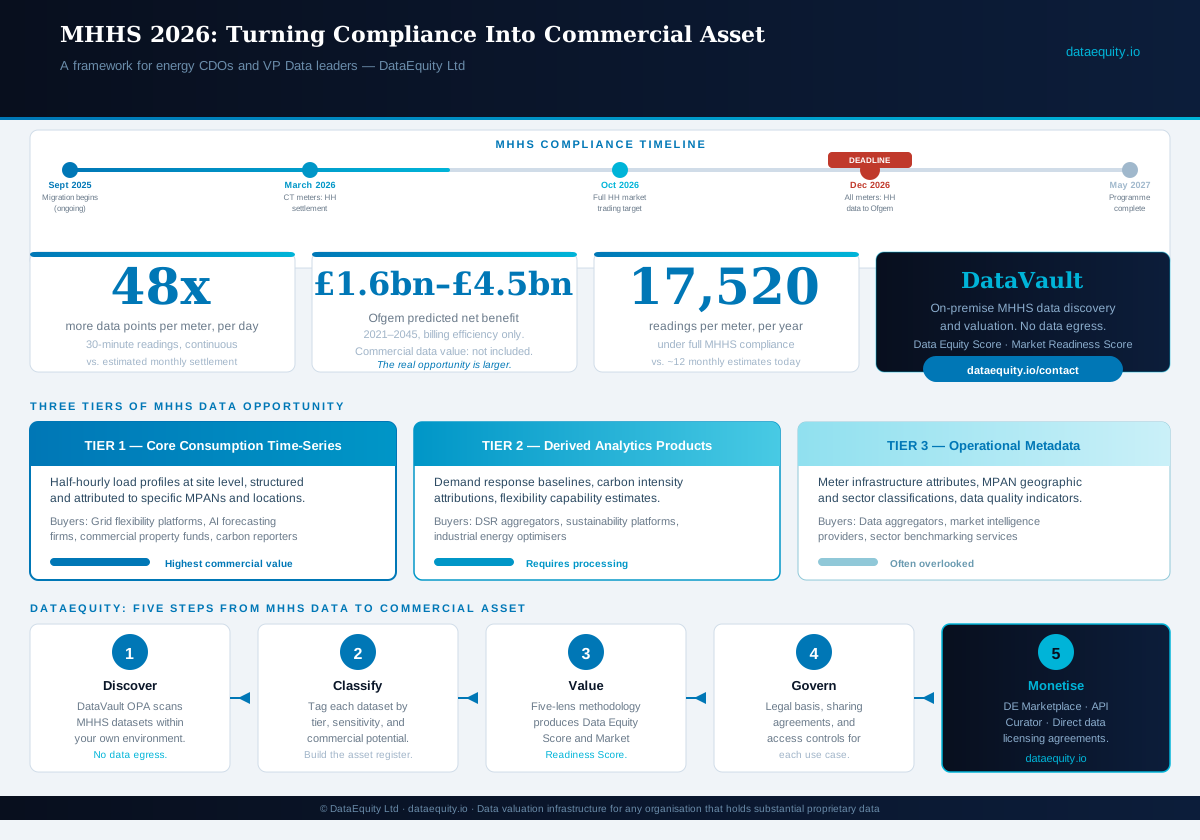
Summarising MHHS as a billing reform underestimates it substantially. The programme - mandated by Ofgem, administered through Elexon, and governed by the Balancing and Settlement Code - requires the entire UK electricity market to settle on the basis of half-hourly consumption data for every metered premises. The migration phase began in September 2025 and runs through to May 2027, with suppliers progressively migrating their meter point administration numbers (MPANs) to the new settlement arrangements. CT-metered customers moved first, in March 2026. Full market-wide trading on half-hourly data is targeted by October 2026, with the final statutory deadline for all metering types set at December 2026.
The data implications are substantial and have received very little strategic attention. A meter that previously generated a single estimated monthly reading will, once migrated, generate 17,520 structured, time-stamped readings per year. Aggregated across a portfolio of commercial and industrial sites, this compounds rapidly. A large industrial group with five hundred sites will accumulate more than 8.75 million data points per year from metering alone - each record linked to a specific location, time window, and infrastructure type. This is the definition of a proprietary, structured, time-series dataset.
The problem is not the existence of this data. The problem is that most organisations operating in this sector have no structured approach to answering the question their boards will eventually ask: what is this worth, and to whom?
The Commercial Value of Half-Hourly Consumption Data
What Buyers Are Already Looking For
The demand side of the energy data market is more developed than most suppliers and network operators realise. Grid flexibility platforms need granular consumption profiles to match demand-side assets to balancing market opportunities and Ofgem's flexibility tenders. AI-driven energy analytics firms need site-level time-series data to train forecasting, anomaly detection, and optimisation models. Commercial property investors use consumption benchmarking to price energy performance risk into real estate valuations. Sustainability and carbon reporting platforms require verified, site-level consumption records as primary inputs, and their compliance obligations are themselves tightening year on year under the UK's Sustainability Disclosure Standards.
None of these buyers want aggregated summaries. They want the structured, high-frequency signal that MHHS mandates - and which, until the migration programme, was not systematically available at national scale.
Approaching a Defensible Valuation
Pricing proprietary datasets is not straightforward, but rigorous methodology exists. The market approach values a dataset by reference to comparable sales or licensing agreements in the data market. The income approach models the net licensing revenue a dataset could generate over its useful commercial life, discounted to present value. The cost approach calculates the expense a third party would incur to replicate the dataset independently.
For MHHS-generated consumption profiles, all three approaches can be applied, and all three yield material numbers. A supplier or network operator holding five years of half-hourly data across a substantial commercial portfolio - with appropriate governance in place - holds an asset that, correctly structured, can support licensing arrangements measurable in millions of pounds per annum. The challenge is that most organisations have not yet run any valuation exercise. Without a structured assessment of what they hold, in what form, at what quality level, and with what governance standing, they cannot approach any buyer with confidence.
Governance Must Come Before Monetisation
Energy companies operating under MHHS will handle data that sits at the intersection of multiple regulatory frameworks, and this must be navigated before any commercial programme can begin. The UK GDPR applies to any data that relates to an identifiable individual - which includes domestic consumption profiles and, in many cases, sole trader and small business accounts. Ofgem's data access framework sets out the conditions under which metering data may be shared with third parties and for what purposes. The Data Use and Access Act, which received Royal Assent in 2025, creates new powers to expand smart data sharing initiatives in energy, but also introduces obligations around portability and consent that organisations need to understand and implement.
For large industrial and commercial consumers, the position is different and often more straightforward: consumption data at this scale is less likely to engage GDPR directly, making it more readily available for commercial use subject to contractual terms. But even here, data sharing agreements, licence terms, and access controls need to be established before market engagement. Organisations that attempt to commercialise MHHS data without first completing this governance work will face delays, regulatory exposure, and reputational risk that is entirely avoidable.
The correct sequence is to discover what the organisation holds, classify it by sensitivity and commercial potential, establish the legal and contractual basis for each use case, and only then approach the market. DataEquity's DataVault platform is designed to support exactly this sequence - scanning and cataloguing data assets within the organisation's own infrastructure, with no data egress, and producing a Market Readiness Score that reflects governance standing as well as commercial potential.
Building a Commercial Data Strategy Around MHHS
Thinking in Tiers
Not all MHHS-generated data carries equivalent commercial value, and energy CDOs should approach their portfolio in tiers rather than treating the compliance dataset as a monolithic whole.
Tier one is the core consumption time-series: half-hourly load profiles at site level, structured and attributed to specific MPANs and geographic locations. This is the highest-value layer and the one most directly sought by grid flexibility platforms, AI forecasting firms, and commercial property benchmarkers.
Tier two comprises the derived signals: demand response capability estimates, carbon intensity attributions, and flexibility baseline calculations. These require additional processing investment but produce market-ready analytics products rather than raw data, and can command premium pricing in sustainability and demand-side response markets.
Tier three is the operational metadata: meter infrastructure attributes, MPAN-level geographic and sector classifications, and data quality indicators. This layer is routinely overlooked in commercial planning but carries genuine value for data aggregators, market intelligence providers, and sector benchmarking services.
A serious commercial data strategy needs to assess the volume, quality, and uniqueness of all three tiers - and match them to specific buyer segments rather than attempting to package the whole dataset for a single market.
The API Route to Commercial Data Products
One increasingly effective model for energy data commercialisation is the productised API: rather than licensing a dataset outright, an organisation exposes a structured query interface that buyers access on a usage or subscription basis. This approach preserves control over the underlying data, supports ongoing recurring revenue, and allows the data holder to set access conditions, throttling, and governance terms that reflect their regulatory position.
For organisations that have already invested in MHHS data infrastructure, the marginal cost of productising that infrastructure as a commercial API is significantly lower than the revenue potential justifies. DataEquity's API Curator product supports this model, helping organisations structure, govern, and price their data APIs as commercial products, with billing and access management integrated into the product architecture.
From Compliance to Commercial Asset: A Framework for Energy CDOs
The Chief Data Officers and VP Data leaders at UK energy companies are, in many cases, already aware that MHHS is a data event as well as a billing event. The gap is not awareness - it is execution: translating strategic recognition into a structured commercial programme that runs in parallel with, and does not delay, the compliance programme.
A practical framework for energy organisations involves four workstreams running concurrently from now through to mid-2027. The first is data inventory and classification: deploying automated discovery tooling to catalogue MHHS-generated datasets as they accumulate, tag by tier and sensitivity, and produce a structured asset register. The second is valuation: running a structured methodology against each asset tier to produce defensible, boardroom-ready estimates of commercial value. The third is governance: establishing the legal basis, data sharing agreements, and access controls required for each intended use case before market engagement begins. The fourth is market engagement: identifying specific buyer segments with active demand for each tier, and initiating commercial conversations with appropriate NDAs and term sheets in place.
Ofgem's predicted £1.6bn to £4.5bn in consumer benefits from MHHS refers to billing efficiency and demand flexibility. It says nothing about the commercial value that sits on the asset side of the equation - in the portfolios of the suppliers, networks, and large consumers who will hold this data. That value does not accrue automatically. It accrues to the organisations that are structured to capture it, and the window for preparation is narrowing.
Frequently Asked Questions
Q1: What is Market-Wide Half-Hourly Settlement (MHHS), and why does it matter as a data event?
Market-Wide Half-Hourly Settlement (MHHS) is an Ofgem-mandated programme requiring all electricity consumption in the UK to be settled using half-hourly meter readings rather than estimated or monthly profiles. Operationally, it is the most significant electricity market reform since 1998. As a data event, it matters because it mandates the continuous, structured generation of granular consumption data at a consistency and scale that has never previously existed in the UK electricity market. Each meter generates 48 readings per day, every day, producing more than 17,500 structured time-series records per year. For any organisation holding a portfolio of metered premises - supplier, network operator, industrial consumer, or property group - this represents the creation of a substantial proprietary dataset with direct commercial value in grid balancing, energy analytics, demand forecasting, carbon reporting, and property benchmarking markets.
Q2: Who owns the half-hourly consumption data generated under MHHS?
Data ownership in the UK energy market is a nuanced question with significant commercial implications. Under the Balancing and Settlement Code and associated licence conditions, metering data flows through a defined chain: from the meter operator and data collector to the data aggregator and then to Elexon for settlement purposes. Suppliers hold a copy of metering data under their licence, and large industrial consumers have rights to access their own consumption data. However, the right to use and commercially exploit this data depends on the contractual relationships across the metering chain, the relevant licence conditions, and any data sharing agreements in place. Organisations should seek clarity on their legal position before pursuing any commercial programme, and should document this assessment as part of their governance baseline.
Q3: How does MHHS data governance interact with GDPR and Ofgem's data access framework?
For domestic and small business meters, MHHS data relates to identifiable individuals and engages UK GDPR obligations. The lawful basis for primary use - billing and settlement - is well established. Secondary commercial use requires either a compatible purpose assessment under Article 6(4) UK GDPR or explicit consent, depending on the intended use case. Ofgem's data access framework governs the conditions under which metering data may be shared with third parties. The Data Use and Access Act, which received Royal Assent in 2025, creates additional powers for smart data sharing in energy, with further obligations on portability and consent that are still being interpreted. For large industrial and commercial portfolios, the position is more straightforward: site-level consumption data at this scale is less likely to engage GDPR directly, making it more readily available for commercial use subject to contractual terms. In all cases, a structured legal basis assessment for each intended use should be completed before market engagement begins.
Q4: What is the realistic commercial value of an energy organisation's MHHS dataset?
Commercial value depends on four variables: volume, meaning how many meters, sites, and years of data the organisation holds; uniqueness, meaning how differentiated the consumption profile is relative to what a buyer could obtain elsewhere; quality, meaning completeness, accuracy, and attribution of the dataset; and governance, meaning whether the data can lawfully and contractually be commercialised. For a large supplier or distribution network operator with millions of meters and well-governed multi-year half-hourly data, income-based valuation methodologies can support licensing revenues in the tens of millions of pounds annually. For smaller organisations with more concentrated or specialised portfolios - a large industrial group, a portfolio property manager, or an EV fleet operator - uniqueness and sector specificity can compensate for volume, producing commercially valuable niche datasets at a smaller scale. No organisation should estimate its data value without running a structured valuation exercise that references comparable market transactions.
Q5: How quickly can an energy organisation build a data monetisation strategy around MHHS data?
With the right tooling and a structured methodology, an initial data inventory and valuation exercise can typically be completed within six to eight weeks. This covers automated discovery of MHHS-related datasets, classification by tier and sensitivity, an initial market readiness assessment, and a prioritised shortlist of commercial use cases. A full commercial programme - including governance documentation, market engagement, and initial buyer conversations - typically takes three to six months from the point at which the inventory is complete. Given that the December 2026 compliance deadline is the point at which the full MHHS dataset begins to accumulate at scale, organisations that begin their data strategy programme now are well positioned to enter the market with a mature, governed commercial proposition in early 2027 - before the majority of their sector has recognised the opportunity.
Q6: What is DataVault, and how does it help energy companies value their MHHS data assets?
DataVault is DataEquity's on-premise data discovery and valuation platform. It deploys within an organisation's own environment using an On-Premise Assessment Agent (OPA), meaning no data leaves the organisation's infrastructure at any point during the assessment process. DataVault scans and catalogues data assets - including structured time-series datasets of the kind generated by MHHS metering systems - and applies a five-lens assessment methodology covering commercial potential, governance readiness, technical quality, market uniqueness, and strategic alignment. The output is two scores: a Data Equity Score, reflecting the intrinsic commercial value of the data asset, and a Market Readiness Score, reflecting how governance-ready the data is for commercial use. For energy companies preparing their MHHS data strategy, DataVault provides the essential foundation layer: a defensible, auditable assessment of what the organisation holds and what it is worth, produced entirely within their own environment and without any of the regulatory or data protection risk associated with sending data to a third party. More information is available at dataequity.io.
The December 2026 MHHS deadline marks the beginning of the commercial opportunity, not the end of the compliance journey. Energy companies that treat their half-hourly consumption data as a byproduct of regulatory obligation will cede a significant and growing commercial advantage to those that treat it as a structured asset on which a revenue programme can be built. To discuss how DataVault can support your MHHS data strategy before the window narrows, contact the DataEquity team at dataequity.io/contact.