
What Is a Digital Ecosystem? A Strategic Guide for 2026
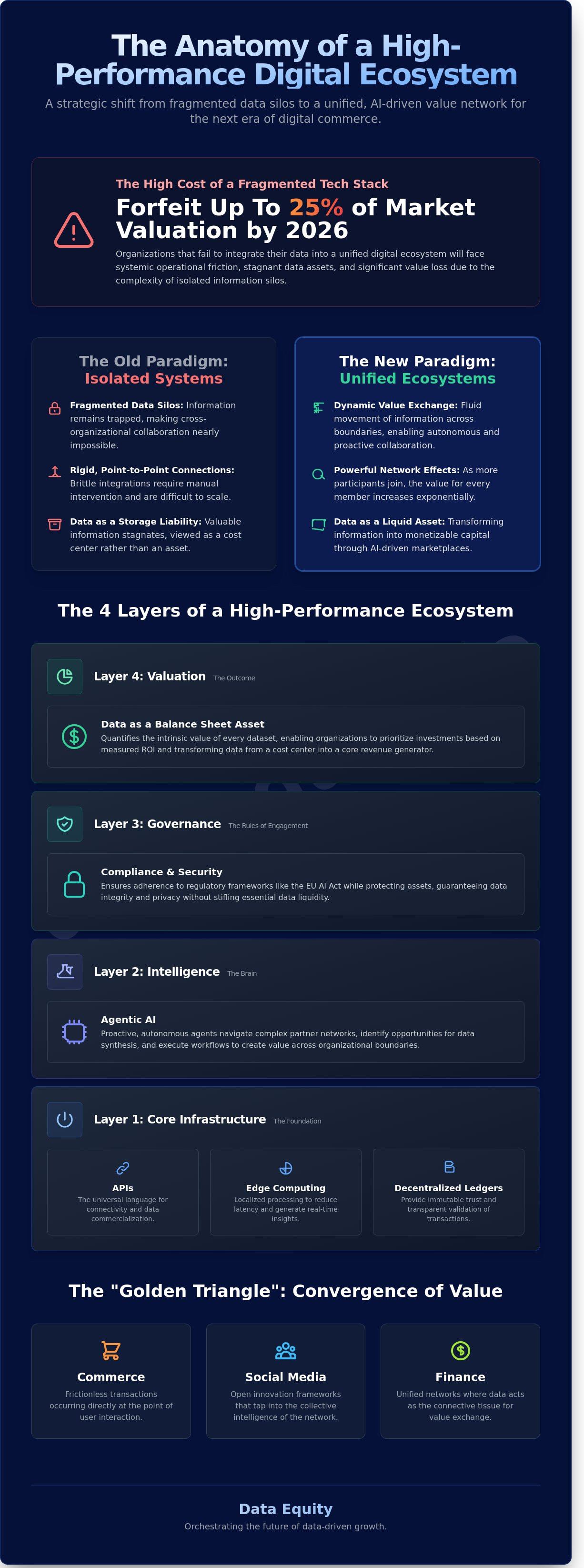
By 2026, organizations that fail to integrate their data into a unified digital ecosystem will likely forfeit up to 25% of their potential market valuation due to systemic operational friction. You probably recognize the inefficiency of managing a fragmented tech stack where information remains trapped in isolated silos, making cross-organizational collaboration nearly impossible. It's frustrating to watch valuable data assets stagnate simply because the complexity of third-party API integrations prevents a clear, actionable view of your total business intelligence.
This strategic guide shifts the perspective from viewing data as a storage liability to treating it as a liquid asset through AI-driven interoperability and value-exchange frameworks. We'll provide a rigorous, step-by-step framework for ecosystem participation, showing you exactly how to value your data assets and leverage autonomous AI agents for network interaction. You'll discover a methodical path to data monetization that replaces executive guesswork with a structured, scalable architecture designed for the next era of digital commerce.
Key Takeaways
-
Understand the evolution from static software suites to a dynamic digital ecosystem where interoperability functions as a primary driver of business value.
-
Evaluate the technical architecture required for high-performance data exchange, focusing on the integration of Agentic AI and decentralized ledgers.
-
Implement strategic mapping tools to audit internal assets and identify high-value data neighbors for collaborative participation.
-
Develop frameworks to transform siloed data into liquid capital by connecting verified sellers with pre-qualified buyers in AI-driven marketplaces.
Defining the Digital Ecosystem in 2026: Beyond IT Infrastructure
The digital ecosystem of 2026 has evolved from a collection of static software suites into a dynamic, adaptive socio-technical system. This transformation marks a departure from traditional IT thinking, where components were selected for individual performance. Today, value is generated through the fluid movement of information across organizational boundaries. We've seen a shift where interoperability is no longer just a technical feature; it has become the core business model. Gartner's 2024 research indicates that by 2026, 75% of market leaders will define their competitive advantage through the depth of their ecosystem participation rather than their internal product features.
In this environment, the location of physical servers has become irrelevant. The boundaries of a modern system are defined by the flow of data and the ability to extract actionable insights from it. Defining these boundaries requires evidence-based assessments that measure the velocity and quality of data exchange. This methodical approach ensures that every connection within the network serves a specific strategic purpose, replacing the "connect-everything" mentality of the previous decade with surgical precision. It's about building a structure where data-driven growth is the natural byproduct of every interaction.
The "Golden Triangle" of Modern Ecosystems
Success in 2026 relies on the convergence of three previously distinct pillars: commerce, social media, and finance. These sectors have merged into unified networks where data acts as the connective tissue. This "Golden Triangle" allows for frictionless transactions that occur exactly where the user interacts. Moving from closed, proprietary systems to open innovation frameworks is mandatory for survival. Organizations that fail to adopt these open standards find themselves isolated, unable to tap into the collective intelligence of the broader network. This transition requires a shift in mindset from ownership to orchestration.
Why Traditional "IT Integration" Is Not an Ecosystem
It's a mistake to confuse simple API connections with a true digital ecosystem. Traditional IT integration is often a rigid, point-to-point setup that requires manual intervention to scale. In contrast, modern ecosystems are characterized by autonomous value exchange and self-organization. They create powerful network effects. As more participants join, the value for every existing member increases exponentially. This scalability isn't possible with standard integration models. A true ecosystem doesn't just connect tools; it facilitates a living environment where value is co-created through predictive analytics and real-time data validation. It's a move from technical implementation to strategic business intelligence.
The Anatomy of a High-Performance Data Ecosystem
A robust digital ecosystem isn't a static repository of software; it's a dynamic architecture designed for frictionless value exchange. The core infrastructure relies on three technical pillars: APIs for connectivity, edge computing for localized processing, and decentralized ledgers for immutable trust. Gartner reports that by 2025, 75% of enterprise-generated data will be created and processed at the edge, outside traditional centralized data centers. This decentralized approach reduces latency and ensures that insights are generated where the action happens, rather than waiting for centralized processing cycles.
The intelligence layer sits above this hardware, where Agentic AI navigates complex partner networks to execute autonomous workflows. This isn't passive automation; it's a proactive system that identifies opportunities for data synthesis across organizational boundaries. To protect these assets, the governance layer must ensure compliance with frameworks like the EU AI Act without stifling data liquidity. Finally, the valuation layer treats information as a balance sheet asset. By quantifying the intrinsic value of every dataset, organizations can prioritize investments based on actual ROI rather than speculative utility.
APIs as the Universal Language
Modern APIs serve as the connective tissue that enables real-time data commercialization. By adopting OpenAPI specifications, businesses lower the barrier to entry for new partners, allowing for rapid scaling of the digital ecosystem. This standardization ensures that disparate systems can communicate without custom middleware. When APIs move from simple data pipes to commercialized products, they transform cost centers into revenue generators.
The Role of AI Agents in Ecosystem Orchestration
The transition from manual data requests to automated metadata analysis marks the rise of "Agentic AI." These autonomous agents don't just find data; they evaluate its quality and relevance for LLM training on behalf of the organization. Instead of human analysts spending 80% of their time on data preparation, agents scan the network to discover high-value datasets. They calculate the strategic worth of information based on its uniqueness and predictive power. This shift allows leaders to focus on high-level strategy while the system optimizes its own internal logic.
The Interoperability and Valuation Gap: Why Most Ecosystems Fail
Most organizations invest heavily in building a digital ecosystem only to find themselves ensnared in the "Silo Trap." While technical connectivity is often achieved through APIs, the actual exchange of economic value remains stagnant. This happens because organizations lack a rigorous framework to quantify what their data is worth to an external partner. Research indicates that 70% of ecosystem initiatives fail not due to technical incompatibility, but because of a fundamental inability to share meaningful value across departmental or corporate boundaries.
Pricing data assets for third-party use presents a significant hurdle. In the current market, many firms still rely on arbitrary, "gut-feeling" pricing models that fail to reflect the actual utility of the information. This lack of precision creates friction. By 2026, deterministic valuation models will replace these subjective estimates, allowing for automated, logic-based pricing that reflects real-world demand and data quality scores. Without this shift, the gap between data availability and data liquidity will continue to widen.
Security concerns often act as the final barrier. There's a constant tension between the need for data privacy and the desire for data liquidity. Organizations fear that opening their systems will lead to proprietary leaks or regulatory non-compliance. To bridge this gap, businesses must move away from "all-or-nothing" sharing and adopt methods that allow for the validation of data value without exposing the raw assets themselves.
Solving the Data Discovery Problem
On-premise discovery agents are becoming essential for secure metadata cataloguing. These tools allow an organization to analyze its data architecture locally, identifying valuable patterns and structures without moving sensitive proprietary information to the cloud. This approach ensures that the digital ecosystem remains secure while still allowing for deep analysis. Evidence-based assessments built on these discovery agents provide the transparency required for buyer trust, proving that the data exists and is formatted correctly before any transaction occurs.
The DataVault Approach to Valuation
Traditional metrics often focus on data volume, yet a massive dataset with low relevance is a liability, not an asset. The DataVault methodology shifts the focus from volume to data utility as the primary pricing metric. By analyzing how a dataset contributes to specific business outcomes, companies can move toward a more rational financial model. You can Unlock Your Data Value by generating a DataVault report, which provides a structured audit of your assets to prove their financial worth to stakeholders. This report serves as a bridge between technical metadata and the balance sheet, ensuring that data is treated as a tangible capital asset.
-
Utility-based pricing: Calculating value based on the predictive power or decision-support capability of the data.
-
Risk-adjusted valuation: Accounting for compliance and storage costs within the total asset value.
-
Standardized reporting: Using DataVault benchmarks to ensure consistency across the entire corporate ecosystem.
Strategic Mapping: How to Architect Your Ecosystem Participation
Architecting a digital ecosystem participation strategy requires a rigorous inventory of your informational capital. You shouldn't treat this as a simple technical integration; it's a deliberate deployment of strategic assets. Start by auditing your internal data assets using automated discovery tools to map out siloed information. Research from Forrester indicates that up to 73% of enterprise data remains unused for analytics. This represents a significant reservoir of untapped value that you can't afford to ignore when seeking marketplace partners.
Once you've mapped your internal landscape, identify "data neighbours" whose datasets complement your own. This synergy is the foundation of high-value partnerships. To facilitate these connections, you must establish a secure API-first architecture. This framework allows for external commercialisation while maintaining strict governance. An API-first approach can increase integration speed by 60% compared to traditional methods. You should also implement a continuous valuation loop to track how your assets appreciate as they interact within the network. Finally, select an AI-driven marketplace to bridge the gap between discovery and sale, ensuring your data reaches the right buyers with minimal friction.
Auditing Your Digital Maturity
Legacy systems often act as the primary bottleneck in modern strategy. You must assess whether your current infrastructure is "ecosystem-ready" or if it will buckle under the demands of real-time data exchange. Metadata cataloguing plays a vital role here; it provides the context necessary for AI integration and machine learning models. Without robust metadata, your data remains a liability rather than an asset.
Building for Scale and Sustainability
Your architecture must handle exponential data growth without performance degradation. Adopting "Open Data" principles is essential for fostering long-term partnerships, as it ensures interoperability across different platforms. Resilience is equally critical. You should design your systems to withstand platform-specific failures, ensuring your operations remain stable even if a major partner experiences an outage. Data-driven firms that prioritise this level of structural integrity see a 25% higher retention rate among their ecosystem partners.
Success in a connected economy depends on precise technical execution and strategic foresight. Partner with Data Equity to refine your architecture and unlock the full potential of your data assets.
From Connectivity to Capital: Commercialising Your Ecosystem
Building a digital ecosystem is a strategic investment in infrastructure that must eventually yield a measurable ROI. While early stages focus on interoperability and internal efficiency, the mature phase centers on data commercialisation. This process transforms internal data silos into liquid assets. Organisations are no longer just data owners who store information; they become data enterprises that generate recurring revenue streams through API-driven access. The goal is to move from data being a cost center, requiring expensive storage and security, to a profit center that funds further innovation.
This shift is significant. Recent industry benchmarks suggest companies treating data as a product see a 15% to 20% increase in valuation compared to peers who view it as a byproduct of operations. Moving from one-off data dumps to live, API-integrated streams ensures that revenue is predictable and scalable. It's the difference between a garage sale and a high-frequency trading platform. The transition from a data owner to a data enterprise involves several key shifts:
-
Moving from static archives to live, API-driven data streams.
-
Shifting from internal-only usage to external commercialisation.
-
Replacing subjective value estimates with deterministic valuation reports.
The AI-Driven Marketplace Advantage
AI has fundamentally changed how data is traded. Traditional data brokerage often suffered from high friction and opaque pricing. Modern AI Data Marketplace platforms eliminate these barriers by using machine learning to match niche datasets with the specific requirements of Large Language Model (LLM) training. AI models require high-quality, verified inputs to reduce hallucinations. Deterministic valuation reports provide the necessary transparency. These reports ensure both buyers and sellers agree on a fair market price based on utility, scarcity, and cleanliness. This precision reduces transaction friction by approximately 40%, accelerating the time-to-market for valuable data assets. Verified data sellers benefit from a transparent audit trail, which increases the trust score of the dataset and justifies premium pricing.
Next Steps: Joining the Global Data Economy
Transitioning from a passive participant to a leader in the global data economy requires a shift in mindset and tooling. It's about discovery and valuation. Data Equity provides the framework to identify untapped assets within your digital ecosystem and quantify their market value. By 2025, the ability to rapidly package and deploy data through secure APIs will be a primary competitive differentiator. Start your data valuation journey with Data Equity to turn your technological connectivity into strategic capital.
Architecting Your Path to Ecosystem Profitability
The transformation of the digital ecosystem by 2026 necessitates a pivot from basic technical integration to the rigorous quantification of data assets. Research indicates that 80% of organizations will struggle to scale their ecosystem participation if they don't address the valuation gap by 2025. Success isn't found in broad connectivity but in the methodical mapping of high-performance data structures that support interoperability. By treating data as a measurable balance sheet item, firms can capture their portion of the $100 trillion in value the World Economic Forum predicts digital platforms will generate this decade.
Navigating this shift requires tools that replace intuition with empirical evidence. DataEquity's deterministic AI-driven valuation engine provides a precise financial baseline, while our secure on-premise discovery agent ensures your internal data remains protected during the audit process. We provide the infrastructure to bridge the gap between technical complexity and commercial reality through a marketplace that links your assets with pre-qualified buyers.
Discover and Value Your Assets with Data Equity
Building a resilient strategy today ensures your organization remains a central node in the economy of tomorrow.
Frequently Asked Questions
What is the difference between a digital platform and a digital ecosystem?
A digital platform is a technical foundation that enables interactions, while a digital ecosystem is the broader network of interconnected organizations, technologies, and consumers that create value together. Platforms like Salesforce serve as a hub, but the ecosystem includes the third-party developers, consulting partners, and integrated apps that expand its utility. Industry analysis projects that ecosystem-driven businesses could represent 60 trillion dollars in revenue by 2030, highlighting that the ecosystem encompasses the entire value chain rather than just the underlying software.
How does an organisation benefit from participating in a digital ecosystem?
Organizations gain access to broader data sets and specialized capabilities that accelerate innovation cycles by up to 30 percent. By participating in a digital ecosystem, a company reduces customer acquisition costs because they leverage existing network effects and shared infrastructure. Industry surveys reveal that 76 percent of executives agree that current business models will be unrecognizable in five years, as ecosystem partnerships allow firms to enter new markets without the overhead of building proprietary systems from scratch.
Is data privacy compromised when joining an open digital ecosystem?
Data privacy isn't compromised if the ecosystem utilizes zero-trust architecture and standardized encryption protocols like AES-256. Modern ecosystems rely on Federated Learning or Clean Rooms where data stays localized while insights are shared. Analysts forecast that by 2025, 60 percent of large organizations will use privacy-enhancing computation techniques to protect data in multipartite environments. These technical safeguards ensure that sensitive information remains siloed even when collaborating with external partners.
What role does AI play in the management of digital ecosystems?
AI automates the orchestration of data flows and identifies anomalies across complex network nodes in real-time. Within a digital ecosystem, machine learning algorithms optimize resource allocation and predict partner performance based on historical API latency and transaction accuracy. Research suggests that AI-driven automation can improve operational efficiency by 25 percent, allowing managers to focus on strategic alignment rather than manual monitoring of interconnected technical dependencies.
How much does it cost to value data assets within an ecosystem?
The cost of data valuation depends on the methodology used, such as the Market, Cost, or Income approach, but industry benchmarks show that specialized audits typically start at several thousand dollars. Organizations often use the Infonomics framework developed by Doug Laney to quantify the economic value of their information. While internal assessments are possible, third-party valuations provide the necessary transparency for mergers, acquisitions, or data-sharing agreements within a collaborative network.
Can legacy systems be integrated into a modern digital ecosystem?
Legacy systems integrate into modern architectures via middleware and RESTful APIs that wrap old code in contemporary interfaces. Approximately 80 percent of enterprise workloads still run on legacy technology, making the use of "headless" configurations or microservices essential for connectivity. This approach allows a 40-year-old mainframe to communicate with cloud-native applications, ensuring that historical data remains an active asset within the broader digital framework.
What are the risks of not participating in a digital ecosystem by 2026?
Companies that remain isolated face a 50 percent higher risk of disruption from agile, network-centric competitors who scale faster through shared resources. By 2026, the lack of ecosystem integration will likely lead to data silos that prevent the use of real-time predictive analytics. Industry analysis shows that companies involved in digital ecosystems see two times higher revenue growth compared to their peers, meaning non-participants will struggle with stagnating market shares.
How do I find the right partners for my digital ecosystem?
Finding the right partners requires evaluating technical compatibility, strategic alignment, and data maturity through a formal vetting process. Organizations should look for partners who maintain high ISO/IEC 27001 standards for information security and demonstrate a proven track record of API stability. Successful ecosystems thrive when participants share a common goal, such as reducing carbon footprints or optimizing supply chains, ensuring that every entity contributes measurable value to the collective.