
The Rise of the Proprietary Data Marketplace: Why AI-Grade Datasets Are the New Enterprise Asset Class
For the past decade, the dominant assumption in enterprise data strategy was that more data meant better AI. Scrape the web. Ingest everything. Volume was the proxy for value.
That assumption is collapsing in 2026, and the organisations that spot it earliest stand to generate an entirely new class of revenue from assets they already hold.
General web-scraped data is devaluing fast. The large model providers have already ingested most of the public internet. What they now need, and are actively paying for, is the data they cannot get themselves: proprietary, sector-specific, compliance-clean datasets from regulated industries. Patient outcomes. SME credit histories. Energy consumption telemetry. Transactional loyalty behaviour. The kind of data that sits inside banks, NHS trusts, utilities, and retailers, largely unrecognised as a commercial asset.
This guide explains why proprietary data has become the new enterprise asset class, what is driving the market shift, and how organisations in regulated industries can move from passive data holders to active market participants, without compromising sovereignty or compliance.
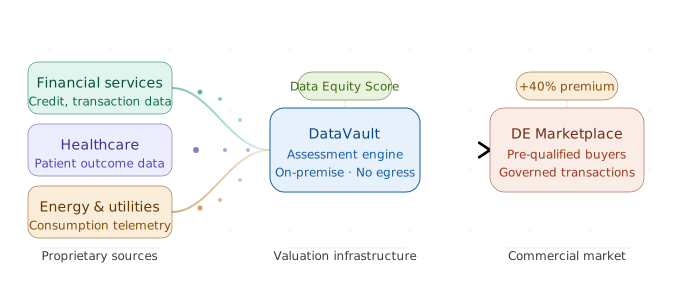
Key Takeaways
- The global AI training dataset market is projected to grow from $4.44 billion in 2026 to $23.18 billion by 2034, with demand shifting decisively toward proprietary, sector-specific data.
- Major platform providers including Salesforce, Slack, OpenAI, and X are shuttering or monetising previously open data APIs, accelerating the scarcity premium on proprietary datasets.
- The UK government is committing £12 million in data sharing infrastructure from April 2026, directly incentivising regulated industries to participate in structured data markets.
- On-premises deployment dominates the AI training dataset market at 56% market share, validating the architecture of platforms that keep data in-situ during valuation and commercialisation.
- Organisations without a structured data valuation framework are entering data markets blind, underpricing assets or avoiding them entirely due to unquantified compliance risk.
- The DataEquity Marketplace provides the governance layer, valuation infrastructure, and buyer access that transforms a raw data holding into a commercial-grade, AI-ready asset.
The Data Scarcity Premium: What Changed in 2025
The internet is not getting more useful for AI training. It is getting noisier, more synthetic, and more legally contested. Copyright disputes, the proliferation of AI-generated content, and the progressive closure of open platform APIs have fundamentally changed what counts as valuable training data.
In 2025, a wave of platform providers restricted or shut down their public data feeds. The implication is significant: the marginal value of another petabyte of scraped web content is approaching zero, while the marginal value of a clean, labelled, consent-verified dataset from a regulated industry is rising sharply.
This creates a structural premium for organisations that hold unique, real-world data and can demonstrate its provenance, completeness, and compliance standing. The question is no longer whether your data has value. It is whether you have the infrastructure to prove and realise that value.
Why Proprietary Datasets Command the Premium
The AI model development pipeline has a quality problem at the data layer. Hallucinations, bias, and domain brittleness are not primarily compute problems, they are data problems. Models trained on generalised, low-quality web data perform poorly in high-stakes vertical applications: clinical decision support, credit risk assessment, fraud detection, energy demand forecasting.
Fixing this requires domain-specific, high-fidelity training data. And the organisations that hold that data, by virtue of operating in regulated industries with rigorous record-keeping requirements, are in a position of genuine market advantage, provided they can navigate the compliance and commercialisation challenge.
Proprietary datasets with high longitudinal depth and verifiable consent trails command a significant premium over generic public data. The key variables that determine where your data sits in that premium range are: uniqueness, completeness, decay rate, and regulatory cleanliness. A dataset that scores well across all four is not just a commercial asset, it is a defensible, recurring revenue source.
The Market Numbers That Should Change Your Strategy
The scale of the opportunity is being consistently underestimated by enterprise data teams, who still tend to think of data commercialisation as a niche activity for technology companies rather than a core revenue strategy for regulated industries.
The global AI training dataset market is valued at $4.44 billion in 2026 and is projected to reach $23.18 billion by 2034, growing at a compound annual rate of 22.9%. This is not a speculative projection, it is being driven by the concrete capital commitments of the largest technology companies in the world, all of whom are competing to fine-tune models on domain-specific data they cannot generate themselves.
Within this market, on-premises deployment accounts for 56% of market share. This is the architecturally critical statistic. It confirms that the market is not asking organisations to centralise their data in third-party cloud environments for valuation and commercialisation. The demand is for in-situ assessment and structured access, which is precisely the model that protects regulated organisations from the data egress risk that has historically made CDOs reluctant to engage.
The sectors driving the fastest growth are healthcare, financial services, and retail, exactly the regulated industries where DataEquity operates. Rising AI deployment in these sectors has boosted dataset demand by 39% for model accuracy improvement in 2026 alone.
The Regulatory Tailwind That Turns Obligation Into Opportunity
The UK's Data (Use and Access) Act 2025 is rolling out in phases through June 2026, and the majority of commentary has focused on its compliance requirements. The more strategically important reading is what it enables.
The DUA Act provides the legal framework to expand Open Banking into broader Open Finance arrangements, covering pensions, investments, and insurance through structured data sharing schemes. The UK government has committed £12 million in data sharing infrastructure from April 2026, coordinating governance, legal, interoperability, security, and trust frameworks across financial services, energy, transport, and retail. A further £36 million has been committed to support new Smart Data schemes in energy and financial services.
This is not regulatory overhead. It is market infrastructure being built at government expense, infrastructure that will enable organisations with well-governed, commercially ready data assets to participate in structured marketplaces with pre-qualified buyers, regulatory sanction, and standardised access frameworks.
The organisations that arrive at this market with a DataVault assessment already completed, with a documented Data Equity Score, a Market Readiness Score, and a clear understanding of their dataset's commercial tier, will negotiate from a position of strength. Those that arrive without one will either undersell or stall entirely.
Why Most Organisations Are Still Leaving Value on the Table
Despite the scale of the market opportunity, the majority of regulated enterprises remain passive data holders. A 2023 study found that up to 68% of enterprise data remains unanalysed, not because it lacks value, but because the internal infrastructure to identify, assess, and commercialise it does not exist.
The barriers are well understood by any CDO who has attempted to move from data strategy to data revenue:
The provenance problem. Data without a verifiable consent trail is a liability rather than an asset. Under UK GDPR and the DUA Act's enhanced compliance requirements, datasets with ambiguous origins face both regulatory risk and market discount. Buyers in structured data markets apply a significant price reduction to datasets that cannot demonstrate a clean compliance standing.
The valuation gap. Traditional accounting treats data as a sunk cost rather than an asset. Without a deterministic valuation methodology, one that quantifies uniqueness, completeness, decay rate, and regulatory cleanliness, organisations have no basis for pricing their data commercially. They are either guessing or not participating at all.
The sovereignty barrier. The most common reason regulated organisations decline to engage with data commercialisation is the rational fear of compromising proprietary intellectual property through centralised cloud assessment. Traditional models that require moving raw datasets to a third-party environment for analysis expose organisations to exactly the breach risk that makes commercialisation unattractive. For a CFO aware that the average cost of a data breach now exceeds $4.45 million, the potential revenue from an external marketplace has historically looked inadequate relative to the downside.
Each of these barriers has a structural solution. The question is whether your organisation has the infrastructure to implement it.
The Architecture of Responsible Data Commercialisation
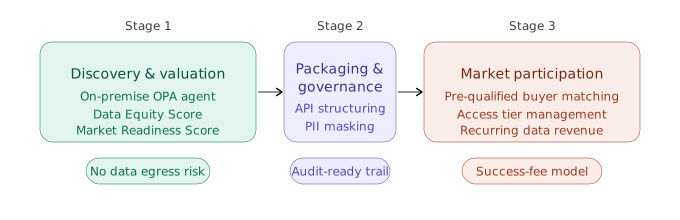
Moving from passive data holder to active market participant requires three things working in concert: in-situ valuation, compliance automation, and structured marketplace access. Organisations that attempt to shortcut any of these three stages tend to either stall on compliance, undersell on value, or fail to find qualified buyers.
In-Situ Valuation: The Foundation
The privacy paradox of data commercialisation, that the process of assessing value traditionally requires exposing the data, is resolved by on-premise discovery architecture. Rather than moving raw datasets to a centralised environment, the assessment logic travels to the data. An On-Premise Assessment Agent catalogues metadata locally, identifying patterns and commercial potential without exfiltrating sensitive records.
This approach reduces the attack surface during the commercialisation lifecycle by approximately 95%. More importantly, it removes the primary objection that prevents regulated organisations from engaging with data valuation in the first place. If your data never leaves its source environment during assessment, the risk calculus changes entirely.
The output of this stage is a DataVault report: a technical and financial audit that quantifies the commercial potential of your existing datasets by applying deterministic valuation methodology across five assessment lenses. Scarcity, accuracy, completeness, regulatory standing, and market demand are each scored and weighted to produce a Data Equity Score and a Market Readiness Score. These are not estimations, they are evidence-based valuations grounded in current market demand signals.
Compliance as Infrastructure, Not Process
Manual compliance review is the bottleneck that kills data commercialisation timelines. It is also the source of 82% of security incidents in data handling pipelines. Modern systems automate PII masking and anonymisation at high accuracy rates, providing a verifiable audit trail for regulators and turning compliance into a transparent, repeatable feature of the data pipeline rather than a gate that requires legal and IT resource to open.
Under the DUA Act's enhanced PECR penalties, now aligned with UK GDPR at up to £17.5 million or 4% of global annual turnover, the compliance infrastructure around data commercialisation is not optional. But when it is built correctly, it is also a commercial advantage. Datasets with a clean consent trail command a 40% price premium in structured data markets over those with ambiguous origins.
Marketplace Access: Matching Assets to Qualified Buyers
The final stage is connecting a validated, compliance-ready dataset with a buyer pool that has already been through rigorous qualification. AI-driven matching in the DataEquity Marketplace reduces sales cycles significantly, from what has historically been a protracted enterprise negotiation to a structured digital transaction. Buyers arrive with defined use cases, confirmed compliance standing, and genuine domain requirements. This is the difference between listing data on an open exchange and participating in a governed market with pre-verified counterparties.
The DUA Act's Smart Data framework is creating exactly this kind of governed marketplace at the regulatory level for financial services, energy, and related sectors. The organisations that have already commercialised their data assets within that framework will have the operational experience, the buyer relationships, and the valuation track record to command premium pricing as the regulated market scales.
What Makes a Dataset AI-Grade in 2026
Not all proprietary data is equal, and understanding where your datasets sit in the commercial hierarchy is the first step to a coherent monetisation strategy. The shift from raw data sales to AI-grade dataset provision is the defining commercial transition of the current market, and it is not primarily about data volume.
Timeliness. Real-time API access commands a price multiplier compared to batch-delivered historical archives. If your dataset can be accessed dynamically and updated continuously, its commercial value increases substantially.
Longitudinal depth. Time-series data with high longitudinal depth is disproportionately valuable for model training. A five-year view of SME credit behaviour, patient outcome trajectories, or energy consumption patterns is significantly more valuable than a point-in-time snapshot, because it captures the temporal dynamics that make predictive models useful in production.
Label quality. A dataset's utility for AI training depends heavily on the quality and consistency of its labelling. Data that has been structured for machine readability, with consistent schema, accurate metadata, and verifiable annotation, commands a premium over raw, unstructured records.
Regulatory cleanliness. In regulated industries, the compliance standing of a dataset is as important as its content. Buyers deploying AI in financial services, healthcare, or energy need data that will withstand regulatory scrutiny. A dataset with a documented, verifiable consent trail and a clean compliance history is fundamentally a different commercial product from one without.
Implementing a Data Marketplace Strategy: The Three-Stage Model
The path from passive data holder to active market participant is well-defined. The organisations that execute it successfully share a common approach: they treat each stage as a prerequisite for the next rather than attempting to compress the process.
Stage 1: Discovery and valuation. Deploy automated discovery tooling to audit legacy systems and identify datasets with commercial relevance. Apply deterministic valuation methodology to establish a Data Equity Score for each candidate dataset. This stage produces the evidence base that all subsequent commercial activity depends on. Without it, you are guessing at price and structure.
Stage 2: Packaging and governance. Transform validated datasets into commercial-grade products. This means structuring assets into robust API endpoints that allow for real-time access and dynamic updates, applying PII masking and anonymisation at scale, and documenting the full provenance chain that buyers and regulators will require. The packaging stage is where raw data holding becomes a commercial product.
Stage 3: Market participation. List validated, packaged datasets in a governed marketplace with pre-qualified buyers. Monitor usage analytics, manage access tiers, and build buyer relationships that generate recurring revenue. The most sophisticated organisations at this stage are operating a genuine data product business alongside their core operations, with all the pricing, tiering, and lifecycle management that implies.
The Window Is Open, But Not Indefinitely
The timing of the UK's data infrastructure investment, the DUA Act Smart Data framework, the FCA Open Finance roadmap, the £12 million infrastructure commitment in April 2026, creates a specific window for regulated organisations to establish position in an emerging market before it normalises.
First-mover advantage in data markets operates differently from other market dynamics because data assets have network effects. Buyers who integrate your dataset into their model training pipelines develop dependency. Usage generates feedback that improves data quality and labelling. Market reputation compounds. The organisations that participate earliest in structured data markets will be better positioned at every subsequent stage of market development.
The organisations that wait, that treat the DUA Act as a compliance exercise rather than a commercial opportunity, and that continue to hold proprietary datasets as operational necessity rather than strategic assets, will find themselves negotiating entry into a market that has already established its pricing dynamics, buyer relationships, and quality benchmarks without them.
The data you hold is already valuable. The question is whether you have the infrastructure to prove it, protect it, and take it to market.
Frequently Asked Questions
What makes a dataset commercially valuable in 2026?
Commercial value in 2026 is determined by a dataset's utility for AI model training and deployment rather than its volume alone. The key variables are uniqueness, whether the data is available elsewhere, completeness, timeliness, label quality, and regulatory cleanliness. Proprietary, sector-specific datasets from regulated industries with verifiable consent trails command a significant premium over generic public data because they solve specific problems that general web-scraped content cannot address.
Can regulated industries commercialise data without compromising compliance?
Yes, provided the architecture is correct. On-premise discovery eliminates the need to move raw data to a centralised environment for valuation or assessment. Automated PII masking and anonymisation handles compliance at scale. And structured marketplace participation with pre-qualified buyers ensures that the commercialisation chain is governed end-to-end. The DUA Act's Smart Data framework provides the regulatory scaffolding for exactly this kind of governed data sharing in financial services, energy, and adjacent sectors.
What is the difference between a data marketplace and a data exchange?
A data exchange is typically an open environment where data is listed and transacted without structured governance. A data marketplace, in the sense that DataEquity operates, involves pre-qualified buyers, structured access frameworks, compliance verification at both ends of the transaction, and AI-driven matching between dataset characteristics and buyer requirements. The governance layer is what makes the difference between a transactional event and a recurring commercial relationship.
How long does it take to go from data discovery to first commercial transaction?
The timeline depends on the maturity of your data governance infrastructure and the complexity of the datasets involved. With the DataVault assessment providing a structured evidence base, and automated compliance tooling handling PII and anonymisation, the process can be completed significantly faster than traditional enterprise data commercialisation timelines. AI-driven marketplace matching further compresses the buyer discovery and qualification phase.
What sectors are seeing the strongest demand for proprietary datasets?
In 2026, the strongest demand is in financial services, healthcare, and energy, the three sectors where AI deployment is growing fastest and where publicly available training data is most inadequate for production use. Within financial services, SME credit behaviour, transaction data, and fraud pattern data are in particular demand. In healthcare, longitudinal patient outcome data is the primary target. In energy, consumption telemetry and grid behaviour data is attracting significant interest from both AI model providers and energy transition analytics firms.
What is the DataEquity Marketplace and how does it differ from other data platforms?
The DataEquity Marketplace connects organisations that have completed a DataVault assessment with a pre-qualified pool of data buyers. Unlike open data exchanges, every dataset listed has a documented Data Equity Score and Market Readiness Score, giving buyers confidence in asset quality and sellers confidence in pricing. The Marketplace operates on a success-fee model, DataEquity earns when you earn, ensuring alignment between platform performance and seller outcomes. Data sovereignty is maintained throughout: the assessment and initial valuation are conducted on-premise, and raw data is never moved to a centralised environment without explicit seller consent.
Get Started with the DataEquity Platform
The DataVault assessment is the foundation of every data commercialisation strategy we support. It gives you the evidence base to understand what your data is worth, the compliance documentation to take it to market, and the Market Readiness Score that tells you how quickly you can move from assessment to commercial transaction.
If you are a CDO, CAO, or data strategy leader in financial services, energy, healthcare, or retail, and you are ready to understand the commercial value of what you already hold, start here.