
The $5 Billion Sports Data Asset Most Organisations Have Never Valued
Sport & Entertainment | 8 min read | April 2026
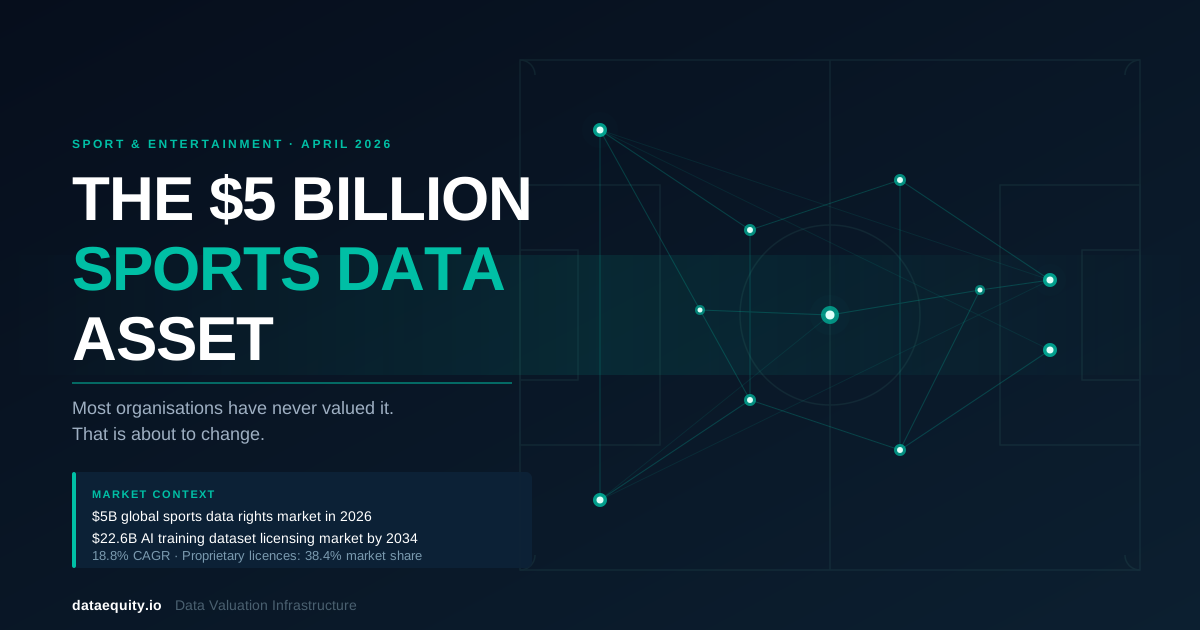
Sports data rights will be worth more than $5 billion globally this year. That figure represents the combined appetite of bookmakers, broadcasters, AI developers, video game studios, performance analytics platforms, and fan engagement companies, all competing to licence proprietary data that only sports organisations generate. The irony is acute: some of the most commercially sophisticated organisations in Britain produce extraordinarily rich data across performance analytics, fan behaviour, venue operations, and athlete biometrics, and the majority have never commissioned a formal assessment of what any of it is worth. In April 2026, both Morgan Lewis and Bristows published analyses of how data rights have become a central commercial tension in sports industry transactions. Their conclusion was unambiguous: data is no longer peripheral to the sports business. For a growing number of clubs, leagues, and governing bodies, it is becoming the primary business.
The challenge is not that sports organisations lack data. It is that most have no systematic view of what data assets they hold, what rights they possess over those assets, or what any of it would be worth to an external buyer. GPS and biometric tracking systems generate millions of data points per fixture. Ticketing and loyalty platforms map the behaviour of hundreds of thousands of fans. Venue sensors capture real-time occupancy, dwell time, and retail spend across complex physical environments. Betting feeds reach global networks in milliseconds. The range and depth of what exists is significant, but it sits across separate systems, managed by separate departments, governed by contracts drafted before the current commercial landscape existed. Without a structured picture of that estate, the commercial opportunity remains theoretical.
Key Takeaways
- Sports data rights are projected to exceed $5 billion globally in 2026, driven by demand from AI model training, betting, broadcasting, and gaming.
- The global dataset licensing market for AI training was valued at $4.8 billion in 2025 and is forecast to reach $22.6 billion by 2034, growing at 18.8% CAGR, with sports biometric and performance data among the most commercially sought proprietary categories.
- Legal ownership of sports data remains genuinely unresolved: athletes generate it, clubs collect it, and leagues control distribution rights, but clear contractual allocation is the exception rather than the rule.
- The EU AI Act mandates provenance documentation for training datasets, meaning AI companies purchasing sports data will increasingly require formal rights clearance and governance evidence before any transaction completes.
- Sponsorship deals and naming rights contracts now routinely incorporate data usage provisions, meaning organisations that cannot articulate their data estate enter negotiations at a structural disadvantage.
- DataEquity's DataVault platform gives sports organisations a structured, on-premise assessment of every data asset they hold, producing a Data Equity Score and Market Readiness Score without any data leaving their infrastructure.
The Data Profile of a Modern Sports Organisation
Five Distinct Asset Categories
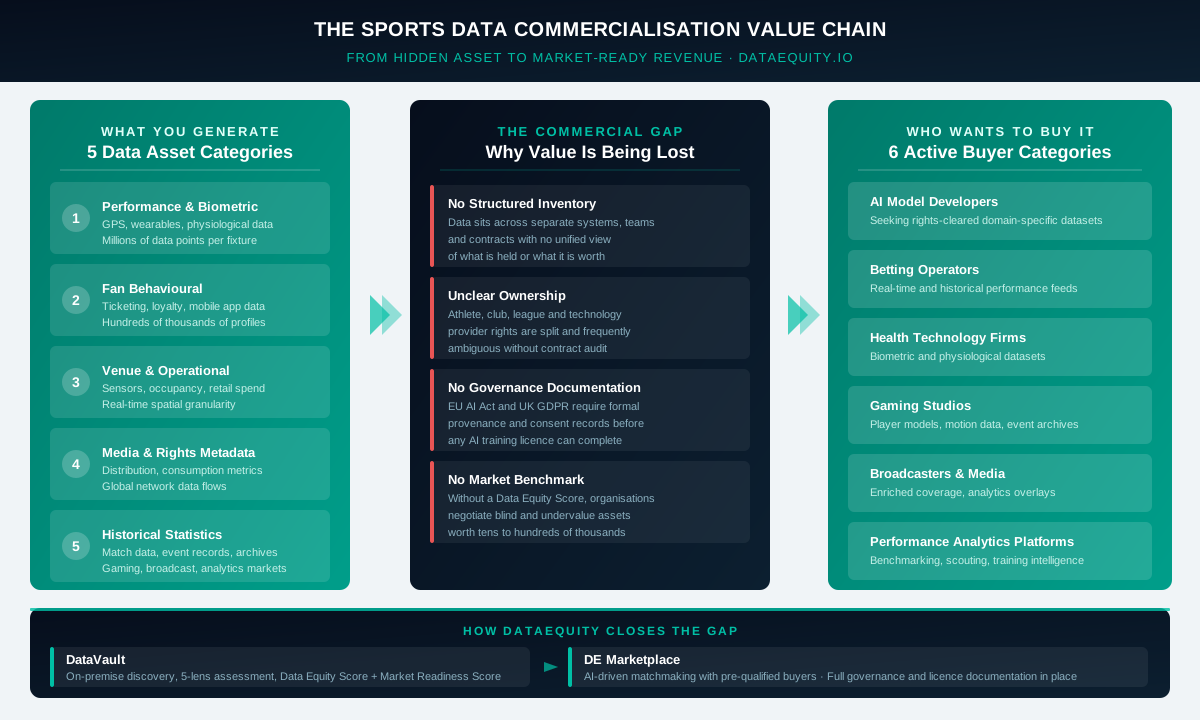
The data generated by a Premier League club, a Formula One team, a county cricket board, or a national governing body is not a single asset. It comprises at least five distinct categories, each with a different commercial profile and a different buyer market.
Performance and biometric data, captured through GPS wearables, optical tracking, and physiological monitoring systems, is unique, longitudinally consistent, and precisely labelled in ways that generic datasets cannot replicate. Fan behavioural data, gathered through ticketing, loyalty programmes, and mobile applications, is valuable to retail brands, media companies, and personalisation platforms. Venue and operational data from sensor-equipped stadiums captures movement, dwell time, and retail spend at a spatial granularity that smart city and event technology firms actively seek. Media and rights metadata documents the distribution and consumption of content across global networks. Historical match statistics and event data underpin a well-established commercial ecosystem in gaming and broadcast rights.
Each category carries a different valuation, a different governance requirement, and a different buyer profile. Most sports organisations cannot provide a structured account of what they hold across all five. That gap is precisely where commercial value is being lost.
The Ownership Problem Nobody Is Solving
Why Data Rights in Sport Are Genuinely Complicated
The ownership question is the most structurally difficult in sports data commercialisation, and it is consistently deferred. Research published in Frontiers in Sports and Active Living concluded that although performance and biometric data originate from athletes' bodies, legal ownership remains uncertain; existing privacy law and international sports governance frameworks offer no clear allocation of rights over the digital traces produced through play or training.
The consequences are practical. Athlete contracts at leading clubs typically include clauses permitting internal use of biometric and performance data for analytics, but the scope of commercial licensing rights for third-party buyers is rarely specified. Technology providers who install tracking hardware frequently retain partial data rights. Leagues control statistical and broadcast data under their own agreements, which can overlap with club-level rights in ways that have not been tested in court. The MLB Players Association addressed this directly in 2022, negotiating a provision prohibiting clubs from selling or licensing confidential biometric and performance data, a step that UK and European governing bodies have not yet taken at scale.
For any AI company, pharmaceutical firm, or analytics platform seeking to licence sports data, unclear provenance is a deal-stopper. Formal rights documentation is not optional; it is the commercial baseline from which any serious buyer negotiates.
The AI Training Data Goldmine
Why Technology Companies Are Actively Seeking Sports Datasets
The global market for licensed AI training datasets was valued at $4.8 billion in 2025 and is forecast to reach $22.6 billion by 2034, growing at 18.8% CAGR. As of early 2026, more than 200 publicly disclosed large language models with over one billion parameters are active globally, each requiring substantial quantities of rights-cleared, domain-specific data to achieve competitive performance. Proprietary licences account for 38.4% of the AI training dataset market, reflecting the structural preference of commercial AI developers for data with defensible legal documentation.
Sports data occupies a position that AI developers find uniquely attractive. It is high-frequency, longitudinally consistent, precisely labelled, and entirely proprietary. A decade of GPS performance data from a Premier League academy cannot be synthesised or scraped from a public source. It can only be acquired from the organisation that generated it. Bristows noted in their April 2026 analysis that rights-cleared, consent-documented sports datasets are among the most actively sought proprietary categories in the AI licensing market.
The EU AI Act is accelerating the formalisation of this demand. Its requirement for transparency around training data provenance creates structural incentives for AI companies to acquire formally licensed, clearly documented datasets rather than relying on informal data arrangements. Sports organisations with clear governance in place will command significantly higher licence fees than those that cannot provide the necessary documentation.
Governance, Consent, and the Regulatory Baseline
What Must Be in Place Before Commercialisation Can Begin
Data commercialisation in sport operates within a regulatory environment that is tightening on multiple fronts. UK GDPR classifies biometric data, including health data and data derived from physiological or behavioural characteristics, as special category data, requiring an explicit legal basis, documented consent, and formal data processing agreements with any third-party licensee. From September 2026, the EU Data Act will require manufacturers of connected products, including wearables and venue sensor systems, to build user data access directly into their products, restructuring control over device-generated data in ways that affect any sports organisation operating in European markets.
The practical implication is that organisations cannot enter commercial data licensing negotiations without first establishing what data they hold, under what terms, and with what consents in place. That assessment must be systematic, covering all systems and storage locations, and it must produce documentation that would satisfy both regulatory scrutiny and commercial due diligence.
DataEquity's DataVault platform is built specifically for this requirement. The On-Premise Assessment Agent analyses data assets across an organisation's full infrastructure without any data leaving the on-premise environment. The output is a Data Equity Score and a Market Readiness Score, accompanied by structured documentation that maps governance status, rights position, and commercial readiness across every data category identified. The on-premise architecture is particularly important for sports organisations, where sensitive athlete and fan data cannot be exposed to external systems during the assessment process.
Turning Assessment Into Revenue
From Valuation to the Market
A data valuation assessment is the starting point, not the end point. Once an organisation understands what data it holds, what rights it has over each category, and how those assets compare to current market pricing for comparable datasets, the commercial path becomes navigable.
The demand side is broader than most sports organisations appreciate. PwC's 2026 Sports Industry Outlook confirmed that technology and data have become central to commercial strategy at the most forward-looking organisations in the sector. AI model developers, betting operators, performance analytics platforms, health technology firms, video game studios, and sponsorship analytics companies are all active buyers of proprietary sports data. The supply of rights-cleared, governance-documented datasets is not keeping pace with that demand; organisations that move early to structure their data estate will command better terms than those that engage the market reactively.
DataEquity's DE Marketplace provides an AI-driven matchmaking layer, connecting sports organisations with a network of pre-qualified buyers for proprietary datasets. For organisations that have completed a DataVault assessment, the transition to the DE Marketplace is structured: from understanding what the data estate is worth, to connecting with qualified buyers, to completing licences with full governance and documentation in place. The organisations that act first will hold a material commercial advantage. The buyers are already in the market. The question is whether your organisation is ready to meet them.
Frequently Asked Questions
What is sports data commercialisation and how is it different from broadcast rights?
Sports data commercialisation is the process of identifying, valuing, and generating revenue from the proprietary datasets produced through sports operations: athlete performance and biometric data, fan behavioural data, venue sensor data, and historical statistics. Broadcast rights cover the audio-visual recording and distribution of events. Data rights are a separate and increasingly valuable commercial layer covering the underlying raw data, at granular resolution and often in real time. Broadcast rights have long been the primary revenue lever for leagues and clubs; data rights represent a complementary and still largely unexploited commercial category.
Who actually owns sports performance data, and what does that mean in practice?
Ownership is currently split and frequently ambiguous. Athletes generate data through their physical activity; clubs collect and store it, often via technology providers who may retain partial rights; leagues control statistical and broadcast data under their own agreements. Before any dataset can be commercially licensed, an organisation needs to audit its contracts, establish what rights it holds clearly, resolve ambiguities with athletes and technology providers, and put consent frameworks in place where personal data is involved. Purported licences built on unclear rights positions are legally vulnerable and, in practice, unsellable to any sophisticated buyer conducting proper due diligence.
What compliance frameworks govern sports data commercialisation in the UK and EU?
UK GDPR and the Data Protection Act 2018 govern the personal data of fans, athletes, and staff. Biometric data is classified as special category data, requiring an explicit legal basis and documented consent. The EU AI Act mandates provenance documentation for datasets used in training regulated AI systems. From September 2026, the EU Data Act introduces "access by design" requirements for connected products, affecting wearable and venue sensor deployments across European markets. Any commercial licensing arrangement must be structured to satisfy all applicable frameworks before a buyer's legal team will allow a deal to proceed.
How long does a data asset assessment take and what does it produce?
A structured assessment using DataVault typically takes between four and eight weeks for a mid-sized sports organisation, depending on the complexity and distribution of the data estate. The On-Premise Assessment Agent is deployed across the full infrastructure, cataloguing and analysing all data assets within the on-premise environment. The output is a Data Equity Score and a Market Readiness Score, supported by a structured report mapping data categories, rights and governance status, market benchmarks, and priority commercial opportunities. No data leaves the organisation's infrastructure at any point during the process.
What financial return should a sports organisation realistically expect?
Revenue depends on data type, quality, rights clarity, and market timing. Rights-cleared GPS performance data with strong longitudinal depth can command licence fees from AI developers ranging from tens of thousands to several hundred thousand pounds per agreement, depending on exclusivity and scope. Fan behavioural datasets with clean consent frameworks carry commercial profiles comparable to customer data in retail or financial services. Venue sensor data has an emerging buyer base in smart cities and event technology. The key variable is not the intrinsic quality of the data; it is the organisational readiness to licence it. Establishing that readiness is precisely what a structured assessment delivers.
What is DataVault and how does it help sports organisations specifically?
DataVault is DataEquity's on-premise data discovery and valuation platform, built for organisations holding substantial proprietary data that cannot be exposed to external systems. For sports organisations, it deploys an On-Premise Assessment Agent across the full data infrastructure, cataloguing and analysing performance, biometric, fan, venue, and historical datasets entirely within the organisation's own environment. The platform applies a five-lens assessment methodology to produce a Data Equity Score, benchmarking asset value against market comparators, and a Market Readiness Score, assessing the governance, documentation, and rights position of each category against what prospective buyers require. Together, the two scores provide the foundation for any serious commercial negotiation, whether that is a bilateral licence, a contribution to an AI training dataset, or a listing on the DE Marketplace. Full details are available at dataequity.io/contact.
Sports organisations are at a commercial inflection point. The market for their data has matured, the regulatory framework is crystallising, and buyers are actively seeking rights-cleared, high-quality proprietary datasets that only sports organisations can provide. The gap between the value embedded in those data estates and the revenue currently being captured is substantial. If your organisation generates significant sports data and has not yet established what it holds, what it is worth, or how to bring it to market, speak to DataEquity at https://www.dataequity.io/contact.