
Every Invoice Becomes a Data Point: How Peppol Is Quietly Creating Finance's Next Structured Data Asset
Finance & eInvoicing | 9 min read | May 2026
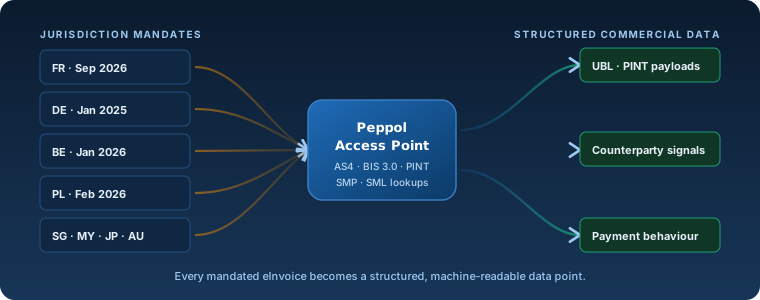
Between 2025 and 2030, the way businesses bill each other will change more than it has in the previous fifty years. Germany has required all B2B invoice recipients to accept structured eInvoices since January 2025. Belgium's mandatory B2B regime began in January 2026. France is migrating its large companies from September 2026, with full coverage by September 2027. Poland's KSeF rollout, Malaysia's phased MyInvois mandate, Singapore's InvoiceNow obligation for newly GST-registered businesses, and the EU's VAT in the Digital Age (ViDA) directive (adopted by Council in March 2025 and applying to cross-border B2B from July 2030) are pushing every supplier, buyer, ERP, bank, and government platform onto a shared digital invoice infrastructure. In most jurisdictions, that shared infrastructure is the Peppol network: an AS4-based, four-corner exchange model overseen by the OpenPeppol Authority and operated by certified Access Points.
That is being discussed almost everywhere as a compliance topic. It is rarely discussed as what it actually is on the asset side: the largest structured B2B transaction dataset ever produced under a common standard. Every cross-border invoice routed through Peppol is, by construction, a UBL or PINT XML document with line items, tax breakdowns, payment terms, counterparty identifiers, and product codes. Multiply that across millions of businesses, dozens of jurisdictions, and a regulatory horizon that runs through the end of the decade, and what emerges is a proprietary, high-frequency, real-time commercial signal that did not previously exist in any structured form. The organisations that move first to treat their Peppol traffic as a data estate, rather than a compliance pipe, will hold a category of asset that the wider market has not yet learned to price.
Key Takeaways
- The global B2B eInvoicing market is projected to grow from roughly $16 billion in 2024 to over $35 billion by 2030, driven primarily by regulatory mandates rather than voluntary adoption.
- More than 50 country Authorities participate in the Peppol network, with mandates already live or scheduled in Australia, New Zealand, Singapore, Malaysia, Japan, Germany, Belgium, France, Poland, and the wider EU under ViDA.
- ViDA, adopted by the EU Council in March 2025, mandates structured eInvoicing and Digital Reporting Requirements (DRR) for intra-EU B2B transactions from July 2030, with member states free to mandate domestic regimes earlier.
- Every Peppol document is a UBL or PINT XML payload with line-item, tax, counterparty, and payment terms data: a structured signal AP automation, working-capital lenders, supply chain risk firms, ESG analysts, and AI forecasting platforms are actively seeking.
- Most finance platforms, ERPs, and corporates are budgeting for Peppol compliance, not for the commercial data architecture sitting on the other side of it. That budgeting gap is the commercial gap.
- DataEquity's DataVault platform lets organisations discover, classify, and value the proprietary invoice and document data their Peppol Access Point will accumulate, entirely on-premise, with Data Equity Score and Market Readiness Score outputs that can be used in board-level commercial planning.
What Peppol Mandates Actually Create, and Why They Are Being Underestimated
Summarising the Peppol mandate wave as "structured eInvoicing for tax purposes" understates it considerably. The legal driver is tax compliance, specifically real-time or near-real-time reporting to tax authorities, fraud reduction, and VAT gap closure. But the standard that delivers it, OpenPeppol's BIS 3.0 and the newer PINT specifications, is not a tax form. It is a fully structured, machine-readable business document standard covering invoices, credit notes, orders, despatch advices, and message-level responses, exchanged over signed AS4 transport through certified Access Points and addressable via the Service Metadata Publisher (SMP) and Service Metadata Locator (SML).
The practical effect is that a transaction that was previously settled with a PDF attachment, an email, and a manual three-way match becomes a structured XML document with persistent identifiers, validated against country profiles at submission, signed in transit, and archived in tamper-evident logs. From an accounting perspective, that is incremental automation. From a data perspective, it is something quite different. Every invoice now carries the same fields, in the same shape, with the same identifiers, across every counterparty and every jurisdiction the business operates in. A counterparty in Singapore, a tax line in Belgium, a payment term in Poland, and a product code in France become directly comparable for the first time, without bespoke integration, OCR, or screen scraping.
A mid-sized supplier exchanging twenty thousand invoices a year through Peppol generates twenty thousand structured records, each with dozens of fields, accumulating into a proprietary multi-year dataset of counterparty behaviour, pricing, and payment dynamics. Aggregated across a portfolio of corporates, a banking customer base, or an ERP's installed base, the volumes compound rapidly. The problem is not the absence of this data. The problem is that almost no organisation today has a structured view of what it holds, what governance applies to it, or what it would be worth to an external buyer.
The Commercial Value of Structured Invoice Data
What Buyers Are Already Looking For
The demand side of the structured invoice data market is more developed than most finance teams realise. AP and AR automation platforms need real, rights-cleared invoice payloads to train extraction, matching, and exception-routing models. Working-capital and supply chain finance lenders price risk against payment behaviour patterns that are only visible at line-item and counterparty level across long time windows. Supply chain risk and procurement intelligence platforms benchmark supplier reliability, lead time variability, and pricing trajectories against datasets exactly of this shape. ESG analytics firms increasingly seek line-item product data to attribute scope 3 emissions accurately. AI forecasting firms, both finance-specific and horizontal, need structured commercial signals that cannot be scraped from public sources.
None of these buyers want PDFs. They want the structured, high-frequency XML signal that Peppol now produces by default, and that, until the current mandate wave, was simply not systematically available at national, let alone cross-border, scale.
Approaching a Defensible Valuation
Pricing proprietary commercial datasets is not straightforward, but rigorous methodology exists. The market approach values a dataset by reference to comparable sales or licensing agreements in the data market, of which there is now a meaningful sample for structured AR and AP data. The income approach models the net licensing revenue a dataset could generate over its useful commercial life, discounted to present value, taking account of refresh frequency and the network effects of additional counterparties. The cost approach calculates the expense a third party would incur to replicate the dataset independently, which for proprietary cross-jurisdiction invoice flow is materially higher than buyers often assume.
For a corporate, a bank, or an ERP holding several years of Peppol-routed transactions across multiple jurisdictions, with appropriate governance in place, the resulting valuation can be measured in millions of pounds of recurring licensing potential. The challenge is that very few organisations have run any structured valuation exercise. Without a defensible assessment of what they hold, in what form, at what quality, and with what governance standing, they cannot approach any buyer with confidence.
Governance Must Come Before Monetisation
Peppol mandates create a structured dataset, but they do not, by themselves, create the right to commercialise it. Invoice data sits at the intersection of multiple frameworks. UK and EU GDPR apply to any line item, contact, or counterparty field that relates to an identifiable individual (sole traders and small business contacts in particular). Tax authorities impose retention obligations and audit access rights over the underlying records. Commercial confidentiality and contractual restrictions in supplier and customer agreements typically govern downstream use. Sectoral rules apply on top, including PSD2 and Open Finance frameworks where invoice data interacts with payments, and the EU Data Act's provisions on data generated by connected products where Peppol traffic touches IoT or telematics.
The practical implication is that organisations cannot move from a working Access Point to a working data product without first establishing what data they hold, under what terms, with what consents and contractual permissions, and against which regulatory regimes. That assessment must be systematic, covering every jurisdiction the business is live in, and it must produce documentation that would satisfy both regulators and commercial due diligence.
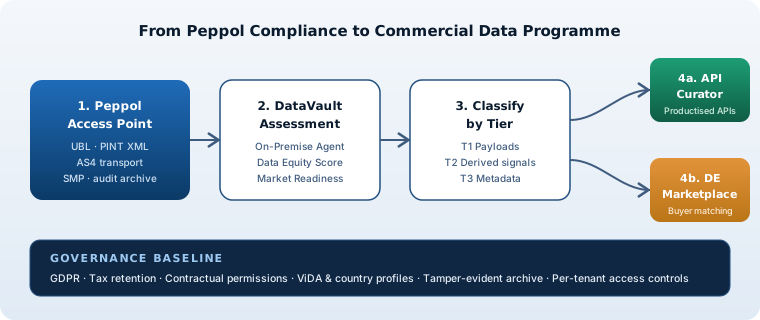
DataEquity's DataVault platform is built precisely for this requirement. The On-Premise Assessment Agent scans data assets across the organisation's own infrastructure, including invoice payload archives produced by the Peppol Access Point, without any data leaving the environment. The output is a structured asset register, a Data Equity Score reflecting commercial value, and a Market Readiness Score reflecting governance and contractual standing. The on-premise architecture matters: invoice flows contain commercially sensitive counterparty data that cannot be exposed to a third-party SaaS assessment, particularly under enterprise procurement and security review.
Building a Commercial Strategy Around Peppol
Thinking in Tiers
Not all Peppol-generated data carries equal commercial value, and finance and data leaders should approach the resulting portfolio in tiers rather than treating it as a monolithic stream.
Tier one is the structured invoice and document payload itself: UBL and PINT records covering counterparty identifiers, line items, tax breakdowns, payment terms, and country profile attributes. This is the highest-value layer and the one most directly sought by AP automation, working-capital lending, and AI training data buyers.
Tier two comprises derived signals built on top of the payload: payment behaviour profiles, counterparty reliability scores, supplier concentration metrics, dispute frequency indices, and product-mix attributions. These require additional processing but yield ready-to-license analytics products that command premium pricing in supply chain finance and risk markets.
Tier three is the operational and network metadata: SMP lookups, document type usage statistics, jurisdiction breakdowns, and Access Point performance attributes. This layer is routinely overlooked but carries genuine value for benchmarking services, fintech infrastructure analytics, and Peppol service providers themselves.
A serious commercial strategy assesses the volume, quality, and uniqueness of all three tiers and matches each to specific buyer segments, rather than attempting to package the whole flow for a single market.
The API Route to Commercial Data Products
The most effective commercialisation model for finance data is rarely a one-off dataset licence. It is a productised, governed API: a buyer pays for usage or subscription access to a structured query interface, while the data holder retains control, sets throttling and access conditions, and earns recurring revenue. For organisations that have already invested in a certified Peppol Access Point, the marginal cost of exposing curated, governance-cleared slices of that data as a commercial API is significantly lower than the revenue potential justifies.
DataEquity's API Curator product supports exactly this model. It sits alongside the Peppol Access Point, allowing finance platforms, ERPs, and corporates to publish structured, rate-limited, contractually wrapped data products on top of their invoice flow, with billing, access management, and audit logging built in.
From Compliance to Commercial Asset: A Framework for Finance and Data Leaders
In most organisations, Peppol compliance sits under tax, finance operations, or IT. The commercial conversation, when it happens at all, sits under data, strategy, or commercial. Bridging the two is the entire work of the next thirty-six months.
A practical framework involves four workstreams running concurrently from now through to the end of the decade. The first is data inventory and classification: deploying automated discovery to catalogue invoice and document payloads as they accumulate at the Access Point, tagging by tier, jurisdiction, counterparty type, and sensitivity. The second is valuation: running a structured methodology against each tier to produce defensible, board-ready estimates of commercial value, refreshed annually. The third is governance: establishing the legal basis, contractual permissions, data sharing agreements, and access controls required before any external use case begins, country by country. The fourth is market engagement: identifying specific buyer segments with active demand for each tier, and initiating commercial conversations under NDAs and term sheets aligned to the governance position.
Peppol mandates are public, dated, and unavoidable. The commercial dataset they will produce is private, proprietary, and largely uncontested today. The organisations that act before that gap narrows will be the ones that show up in 2028 with a mature, governed, productised data programme already generating revenue, while the rest of the sector is still treating eInvoicing as a tax line item.
Frequently Asked Questions
Q1: What is Peppol, and why is it the standard underneath so many national eInvoicing mandates?
Peppol (Pan-European Public Procurement Online) is an open, four-corner exchange network, governed by the OpenPeppol Authority, that allows businesses and governments to exchange structured electronic documents (invoices, credit notes, orders, despatch advices) over a secure AS4 transport, using a common document standard (BIS 3.0, and the newer PINT specifications for non-EU jurisdictions). Country Authorities accredit Access Points and Service Metadata Publishers, ensuring interoperability across borders. National regulators have repeatedly chosen Peppol as the underlying infrastructure for their eInvoicing mandates (in Australia, New Zealand, Singapore, Malaysia, Japan, Belgium, and others) precisely because it removes the need for each business to integrate bilaterally with every counterparty: a single connection to a certified Access Point delivers reach across the whole network.
Q2: Which jurisdictions have already mandated or scheduled B2B eInvoicing on Peppol or compatible infrastructure?
Germany has required B2B invoice recipients to accept structured eInvoices since January 2025, with phased sending obligations through 2027 and 2028. Belgium mandated B2B eInvoicing from January 2026. France is migrating large companies from September 2026 and SMEs by September 2027. Poland's KSeF programme has been rescheduled and is targeted at full mandatory rollout from February 2026. Italy continues its long-standing SdI regime. At EU level, VAT in the Digital Age (ViDA), adopted by the Council in March 2025, mandates structured eInvoicing and Digital Reporting Requirements for intra-EU cross-border B2B from July 2030. Outside the EU, Australia has had Peppol-based B2G since July 2022, New Zealand operates Peppol nationally, Singapore's InvoiceNow is mandatory for newly GST-registered businesses and is expanding, Malaysia's MyInvois rollout is phased through 2024 and 2025 by taxpayer size, and Japan's qualified invoice system aligns with JP PINT. The UK has consulted on eInvoicing through HMRC and has not yet announced a mandatory regime, but the policy direction is clear.
Q3: Is Peppol traffic the property of the business that sent it, the business that received it, or the Access Point?
The short answer is that the legal position varies by jurisdiction, by contract, and by document role, and any organisation planning to commercialise Peppol-derived data should document its position explicitly before doing so. In general, both the sender and the recipient hold copies of the underlying business document under their respective accounting and tax retention obligations. The Access Point is typically a processor for transmission purposes, with its rights defined by the service contract. GDPR applies to any field that relates to an identifiable individual, regardless of which side of the four-corner model holds it. Commercial confidentiality clauses in master services agreements and supplier contracts often restrict downstream use of the underlying transaction data, and these must be reviewed before any commercial programme. None of this prevents commercialisation: it simply means the legal and contractual baseline must be established by design, not discovered after the fact.
Q4: What is the realistic commercial value of an organisation's Peppol-derived invoice data?
Commercial value depends on four variables: volume (how many documents per year, across how many counterparties and jurisdictions), uniqueness (how differentiated the flow is relative to what a buyer could obtain elsewhere, typically driven by sector and cross-border breadth), quality (completeness and accuracy of the underlying payloads, including country profile validation), and governance (whether the data can lawfully and contractually be commercialised). For a large corporate or an ERP with substantial cross-border flow and well-governed multi-year payloads, income-based valuation can support meaningful annual licensing revenues. For smaller players, sector specificity often compensates for volume: niche, well-curated portfolios in pharmaceuticals, energy, logistics, or construction routinely attract specialist buyers at attractive unit prices. No organisation should estimate value without running a structured valuation exercise that references comparable market transactions and accounts for governance position.
Q5: Where does DataEquity's Peppol Access Point fit in this picture?
DataEquity operates a certified, multi-tenant Peppol Access Point and SMP, designed for ERPs, banks, accounting platforms, and governments that need to send and receive compliant eInvoices across every Peppol jurisdiction through a single REST API. The Access Point sits at the compliance layer: it handles AS4 transport, BIS 3.0 and PINT validation, signing, SMP lookups, webhook delivery, and tamper-evident archive. Sitting on top of it are the products that turn that compliance investment into a commercial data programme: DataVault for on-premise discovery and valuation of the resulting invoice estate, API Curator for productising governed slices of that data as commercial APIs, and DE Marketplace for connecting to qualified data buyers. The developer portal, sandbox, and API reference are at peppol.dataequity.io; the product overview is at dataequity.io/products/de-peppol-access-point.
Q6: How quickly can an organisation move from a working Access Point to a commercial data programme?
With the right tooling and a structured methodology, an initial inventory and valuation exercise across Peppol-derived data typically completes within six to eight weeks. That covers automated discovery of invoice and document payloads, classification by tier and jurisdiction, an initial governance and contractual review, and a prioritised shortlist of commercial use cases. A first productised API or a first dataset licensing engagement typically follows three to six months later, depending on contractual complexity and buyer pipeline. The organisations that begin this work in 2026, as their Peppol traffic starts to accumulate in earnest under the new mandates, will be the ones in market with a mature, governed, productised proposition by 2028. Every month the work is deferred is a month of structured commercial data being generated, archived, and not yet positioned for the buyers already looking for it.
The Peppol mandate wave is happening regardless of whether finance, IT, or data leadership treats it as a commercial event. The compliance work will be completed by someone in every affected organisation. The question is whether the structured, proprietary, cross-jurisdiction dataset that compliance produces is left as a tax archive or built into a revenue programme. To discuss how DataEquity's Peppol Access Point, DataVault, and API Curator combine to support that journey, contact the DataEquity team at dataequity.io/contact or explore the developer portal at peppol.dataequity.io.