
The FCA's Open Finance Roadmap Changes Everything: Is Your Data Ready to Compete?
Open Finance Regulation | 7 min read | April 2026
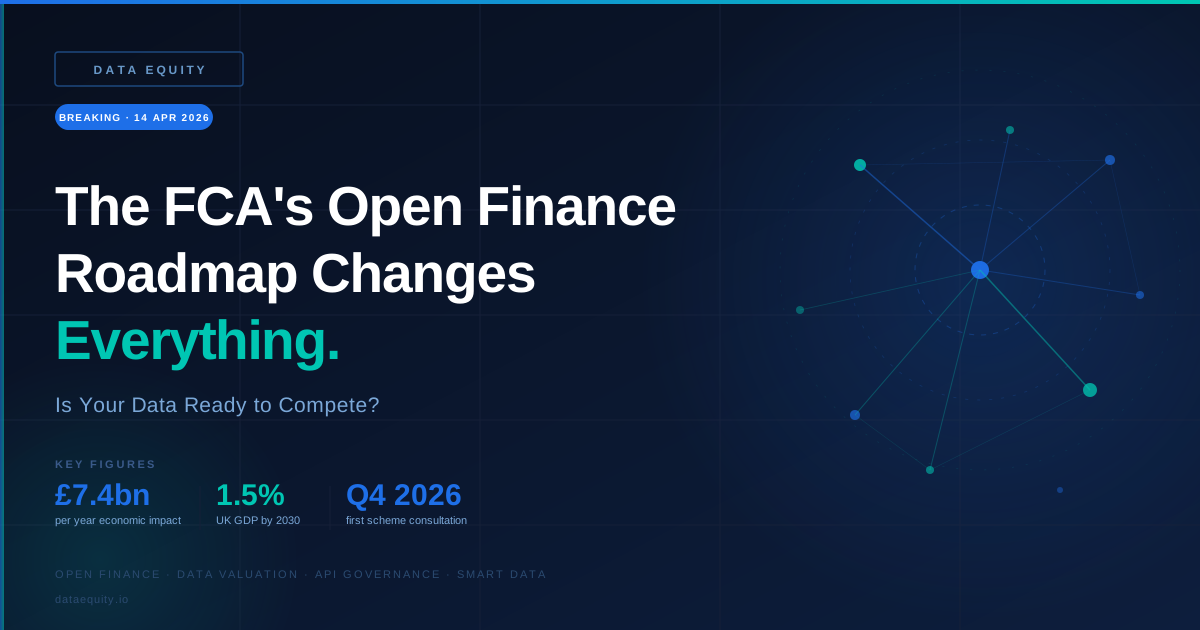
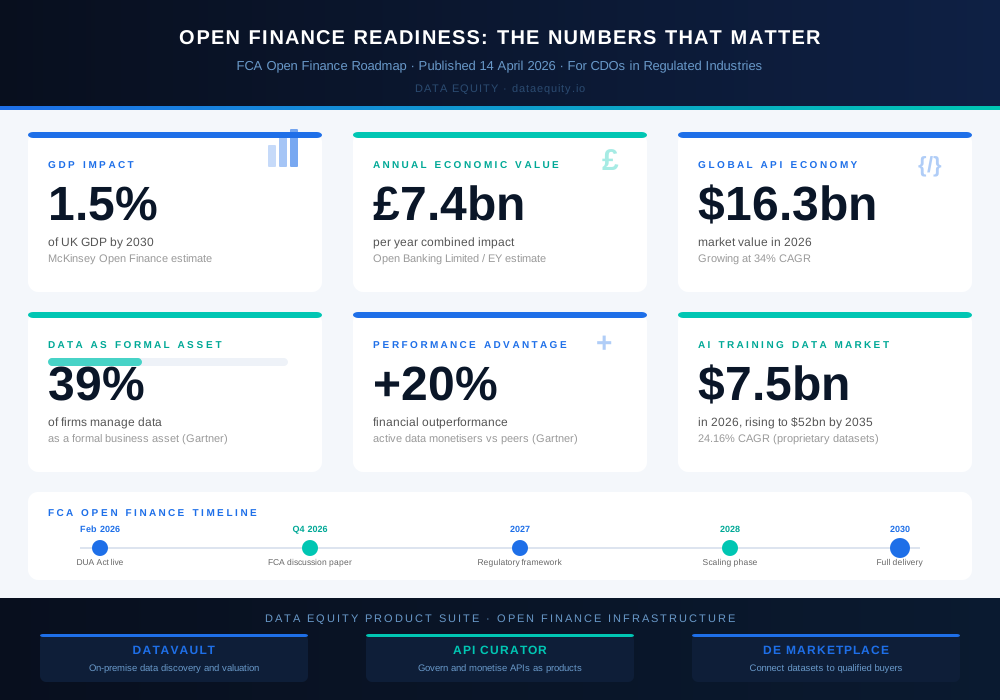
On 14 April 2026, the Financial Conduct Authority published the document that will define British financial services for the rest of this decade. The Open Finance Roadmap to 2030 does not extend Open Banking. It replaces the underlying premise of it. Secure financial data sharing in the UK is moving beyond payment accounts into investments, mortgages, savings products, and SME credit, bringing the full balance sheet of British consumers and businesses into a single regulated data-sharing ecosystem. McKinsey estimates this shift could contribute up to 1.5% of UK GDP by 2030. Open Banking Limited and EY put the combined annual economic impact of Open Banking and Open Finance at £7.4 billion per year within five years. Yet most regulated organisations, the very institutions whose data will underpin this transformation, approach this inflection point without a structured understanding of what their data assets are worth, without commercial governance frameworks for their APIs, and without any credible methodology for determining whether they are ready to participate at all. The dominant assumption that Open Finance is an evolution of Open Banking is wrong. It is a step change in the commercial value of every proprietary financial dataset in existence.
The architecture required to capture that value is not primarily a technology question. It is a data readiness question. The organisations that will monetise Open Finance are those that can demonstrate what their data is worth, govern how it is exposed through APIs, and connect the proprietary datasets that fall outside regulated schemes to qualified buyers who will pay a market rate for domain-specific financial data. That infrastructure, the capacity to value, structure, and commercialise data assets systematically without compromising the security controls that regulated organisations cannot relax, is precisely the capability gap that most organisations have not yet addressed.
Key Takeaways
- McKinsey estimates Open Finance could contribute up to 1.5% of UK GDP by 2030, with Open Banking Limited and EY projecting a combined economic impact of £7.4 billion per year within five years of full deployment.
- The FCA will publish its first formal discussion paper on an Open Finance scheme in Q4 2026, with a long-term regulatory framework to follow through 2027, making data readiness work an immediate priority, not a future consideration.
- Only 39% of organisations currently manage data as a formal business asset, despite Gartner research showing that active data monetisers outperform competitors by 20% on financial metrics.
- The global API economy is valued at $16.29 billion in 2026 and growing at a 34% compound annual growth rate, with financial services accounting for 28.8% of API management market share, yet most institutions still treat APIs as technical plumbing rather than commercial products.
- The AI training dataset market is valued at $7.48 billion in 2026 and projected to reach $52.41 billion by 2035 at a 24.16% CAGR, driven by demand for domain-specific financial, healthcare, and energy datasets, precisely the assets that regulated organisations hold.
- DataEquity's DataVault platform is the only on-premise data valuation infrastructure purpose-built for regulated organisations, producing a verified Data Equity Score and Market Readiness Score without data egress, making it the foundation for any credible Open Finance readiness programme.
From Open Banking to Open Finance: What the FCA's Roadmap Actually Says
The FCA's Open Finance Roadmap to 2030, published on 14 April 2026, sets out what the regulator describes as a clear path to move Open Finance from vision to delivery between now and the end of the decade. This is not aspirational language. The document establishes a concrete four-phase programme backed by the legislative authority of the Data (Use and Access) Act 2025, which received Royal Assent in June 2025 and has been progressively enacting provisions throughout 2025 and into 2026.
What Falls Within Scope
The roadmap draws investments, mortgages, savings accounts, and SME credit into the regulated data-sharing framework, sectors that were entirely outside the scope of Open Banking's payment-account focus. The FCA's initial priority use cases are deliberate in their economic rationale. The first is accelerating SME credit access, where data fragmentation currently costs small businesses weeks in loan application processing. The second is improving consumer access to mortgages, where a lack of portable financial history disadvantages first-time buyers and those with non-standard income profiles. Both use cases represent markets where better access to financial data creates measurable economic value, which is precisely the signal the regulator is sending about where Open Finance will begin to bite.
The Regulatory Timeline
Throughout 2026, the FCA's Smart Data Accelerator and its PRISM Taskforce (Prioritisation and Real-world Insights Selection Matrix) will develop practical use cases in consultation with industry participants, consumer groups, and fellow regulators. A formal discussion paper on the first Open Finance scheme arrives in Q4 2026. A long-term regulatory framework will be developed with HM Treasury through 2027. Scaling and delivery will dominate the 2028 to 2030 period. This is a tightly structured programme. Organisations that wait for the formal consultation before beginning their data readiness work will find themselves building infrastructure under regulatory pressure rather than commercial advantage.
The Data Readiness Gap: Why Most Organisations Will Be Left Behind
Here is the uncomfortable reality for most regulated organisations: despite years of investment in data infrastructure, the majority cannot answer three fundamental questions about their data assets. What is the commercial value of the data they hold? Which datasets are technically and legally ready to be shared through a regulated Open Finance scheme? And which proprietary datasets carry independent commercial value that could be monetised entirely outside regulated channels?
Gartner's research is instructive. Despite broad executive acknowledgement that data is a strategic asset, only 39% of organisations formally manage data as a business asset. Fewer still have applied structured valuation methodology to understand which datasets generate or could generate measurable commercial value. This is not a governance failure in isolation. It reflects a structural absence of tooling capable of assessing data value in situ, without requiring sensitive data to leave the organisation's controlled environment.
The On-Premise Constraint in Regulated Sectors
Financial services, healthcare, and energy organisations face a specific constraint that is absent from the broader data management market: their most valuable data is also their most sensitive. Regulatory obligations, contractual restrictions, and competitive concerns mean that cloud-based data discovery and valuation tools (the default offering from most data catalogue vendors) are frequently unusable for the datasets that matter most. A mortgage lender cannot route full customer transaction history through a third-party SaaS assessment platform. An energy company cannot send grid and consumption data through a cloud valuation engine without triggering obligations under both UK GDPR and the EU Data Act, which entered full application in September 2025.
DataEquity's DataVault platform addresses this directly. The On-Premise Assessment Agent (OPA) performs data discovery, quality assessment, and commercial valuation entirely within the organisation's own infrastructure. No data leaves the controlled environment at any point. The output is a structured, board-ready assessment of which assets are ready for regulated sharing, which require remediation, and which carry standalone commercial value in the proprietary market.
APIs as Commercial Products: The Infrastructure Demand the Roadmap Creates
Open Finance does not operate through database extracts or file transfers. Every data-sharing obligation created by the FCA's Open Finance schemes will be fulfilled through APIs, and commercially captured by organisations that have structured, documented, priced, and governed those APIs as products. This is a non-trivial capability gap for most regulated organisations, whose APIs have historically been built as technical integration points rather than commercial assets.
The scale of the opportunity is visible in current market data. The global API economy is valued at $16.29 billion in 2026 and growing at a 34% compound annual growth rate, driven by the convergence of Open Finance mandates, cloud infrastructure, and AI-powered integration. The average enterprise now manages 354 APIs, up from 200 just two years ago. Yet despite this proliferation, only 52% of executives describe APIs as a substantial revenue stream. Far fewer have applied formal commercial frameworks (pricing models, access tiers, contractual terms, lifecycle governance) to the APIs they operate.
From Technical Asset to Commercial Product
The distinction between an API as a technical asset and an API as a commercial product is significant. A technical API exists to facilitate integration. A commercial API has a defined consumer segment, a pricing structure, a usage policy, a support tier, and a lifecycle governance framework that ensures it remains fit for commercial purpose. The FCA's Open Finance schemes will require the latter. Not because the regulator mandates commercial pricing, but because organisations that treat API access as a commercial product will capture the value that Open Finance creates, while those that treat it purely as a compliance obligation will bear the cost without capturing the return.
DataEquity's API Curator (DE Curator) provides the governance layer that transforms existing APIs into structured commercial products, with tooling for API inventory management, schema standardisation, commercial policy definition, and buyer-facing documentation. For organisations managing both a regulated data-sharing obligation and a proprietary API commercialisation strategy simultaneously, API Curator provides the infrastructure to run both workstreams without duplicating governance overhead.
The Proprietary Data Opportunity: Beyond the Regulated Schemes
Open Finance creates a regulated floor for data sharing, defining the minimum that participating organisations will be required to enable. But it simultaneously creates a commercial ceiling: a market context in which proprietary financial datasets, particularly those with the depth, history, and sector specificity required to train AI models or provide competitive intelligence, are being valued at levels with no recent precedent.
The AI training dataset market is the clearest proxy. Valued at $7.48 billion in 2026 and projected to reach $52.41 billion by 2035 at a 24.16% CAGR, this market is being driven by demand for domain-specific datasets in precisely the sectors where regulated organisations operate. Financial transaction data, energy consumption patterns, and healthcare outcomes datasets are the raw materials for the next generation of AI applications. The organisations that hold them are the only ones that can supply them, and the Dataset Providers Alliance, established in June 2025, has begun formalising commercial norms for exactly this kind of proprietary data licensing.
The challenge for most data owners is not supply. It is discovery: identifying which assets have commercial value, at what price point, to which qualified buyers, under what contractual and governance conditions. This is a market infrastructure problem, and DE Marketplace, DataEquity's AI-driven data marketplace, is built to solve it. It connects data owners who have completed the DataVault assessment process with a network of pre-qualified buyers seeking proprietary datasets. The qualification layer on both sides is what makes this commercially viable: buyers access datasets that have been assessed for quality, governance, and commercial readiness; sellers reach buyers whose use cases and compliance requirements have already been verified.
Building Your Open Finance Data Strategy Now
The FCA's discussion paper on the first formal Open Finance scheme arrives in Q4 2026, approximately six months from today. For organisations that currently have no structured view of their data assets, no commercial governance framework for their APIs, and no mechanism for assessing proprietary dataset value, six months is not a comfortable timeline. It is the minimum viable runway.
The practical sequence is clear. First: conduct an on-premise assessment of existing data assets to establish what is held, what quality standard it meets, and what the regulatory and governance conditions for sharing would be. Second: establish commercial governance for APIs, treating them as products with defined consumers, pricing, and lifecycle management rather than as technical infrastructure. Third: identify the proprietary datasets that fall outside regulated sharing obligations but carry independent commercial value, and establish the contractual conditions under which those assets can be monetised.
This is not a sequence that requires a multi-year transformation programme. DataVault deploys within a regulated environment without data egress. API Curator applies to an existing API estate without rebuilding underlying infrastructure. DE Marketplace connects assessed datasets to qualified buyers as soon as a dataset has passed the readiness threshold. The FCA set the clock on 14 April 2026. The organisations that treat that date as a starting gun rather than a distant signal are the ones that will be commercially positioned when the first formal scheme consultation lands.
Frequently Asked Questions
Q1: What is Open Finance and why does the FCA's new roadmap matter to regulated organisations?
Open Finance is the extension of Open Banking principles beyond payment accounts into the full range of financial products: investments, mortgages, savings, pensions, and SME credit. It gives consumers and businesses the right to share their financial data with authorised third parties across all product categories, not just current accounts. The FCA's roadmap, published 14 April 2026, establishes the path for delivering this by 2030, backed by the Data (Use and Access) Act 2025. For regulated organisations, the roadmap creates both obligations and commercial opportunities. The obligation is to participate in regulated data-sharing schemes as they come into force from 2027 onwards. The commercial opportunity is to establish data readiness infrastructure now, so that when formal schemes arrive, the organisation can comply efficiently, monetise data products commercially, and reach qualified buyers for proprietary assets that fall outside regulated channels entirely.
Q2: How does the DUA Act 2025 interact with existing UK GDPR obligations for financial services firms?
The Data (Use and Access) Act 2025 amends UK GDPR rather than replacing it. Key provisions have been entering into force in stages: the first tranche in August 2025, further amendments on 5 February 2026, with the ICO setting a June 2026 deadline for compliant complaints processes. For financial services organisations, the most practically relevant changes concern the Smart Data scheme framework, which creates a statutory basis for regulated data sharing without requiring individual consent for each sharing event, provided the data controller has a compliant governance framework in place. The Act also reforms the legitimate interests assessment and introduces administrative simplifications for lower-risk processing activities. Organisations should ensure their data governance policies have been reviewed against the February 2026 amendments as the baseline for any Open Finance readiness programme.
Q3: What does data readiness actually mean in the context of Open Finance participation?
Data readiness means that a dataset meets the quality, governance, and technical standards required for it to be shared through a regulated Open Finance scheme or as a commercial product. In practice, this requires the dataset to be discoverable and catalogued within the organisation; its quality to have been assessed across defined dimensions such as completeness, accuracy, consistency, and timeliness; its lineage and usage rights to be documented; and a governance framework to be in place specifying access conditions, contractual protections, and lifecycle management. Most organisations find, on their first structured assessment, that a significant proportion of their highest-value datasets fail one or more of these criteria. Identifying and remediating those gaps before the Q4 2026 consultation begins is the core commercial rationale for investing in data readiness infrastructure today.
Q4: What is the ROI case for investing in data readiness and API governance before formal Open Finance schemes are enacted?
The ROI case operates on two timescales. In the near term, organisations that have completed structured data asset assessments can respond to scheme consultations rapidly, reducing compliance implementation costs and time-to-market for new data products. Gartner estimates that organisations actively monetising their data assets outperform competitors by 20% on financial metrics. Over the medium term, the commercial upside from treating APIs as revenue-generating products is material: the API economy is growing at 34% CAGR, and financial services already account for 28.8% of API management market share globally. Organisations that establish commercial API governance frameworks before regulatory mandates arrive will be able to price, package, and distribute data products at scale, rather than building that capability under time pressure once formal schemes come into force.
Q5: How should a Chief Data Officer structure an Open Finance readiness programme over the next six months?
The most effective approach is sequential rather than parallel. Start with an on-premise assessment of existing data assets to produce a verified inventory of what is held, what quality it meets, and what the gap is between current state and Open Finance readiness. This output informs every subsequent decision and provides the board-level business case for further investment. With that assessment in place, prioritise API governance: identify which APIs will be in scope for early Open Finance schemes and establish commercial governance frameworks before those schemes come into force. Concurrently, identify proprietary datasets that fall outside regulated sharing obligations and assess their standalone commercial value. The Q4 2026 FCA discussion paper is the most important near-term milestone; being prepared to engage substantively with that consultation requires structural data readiness work beginning now.
Q6: What is DataVault and how does it help organisations prepare for Open Finance?
DataVault is DataEquity's on-premise data discovery and valuation platform, built specifically for regulated organisations that cannot use cloud-based assessment tools for their most sensitive datasets. The platform deploys an On-Premise Assessment Agent (OPA) that performs comprehensive data discovery, quality assessment, and commercial valuation entirely within the organisation's own infrastructure; no data leaves the controlled environment at any point. DataVault assesses data assets across five lenses and produces two outputs: a Data Equity Score, quantifying the commercial value of each dataset, and a Market Readiness Score, assessing how prepared each dataset is for regulatory participation or commercial sharing. For organisations preparing for the FCA's Open Finance schemes, DataVault provides the structured, board-ready data asset assessment that is the prerequisite for any credible readiness programme. For organisations with proprietary datasets carrying independent commercial value, the Market Readiness Score is the entry credential for DataEquity's DE Marketplace, where assessed datasets are matched to pre-qualified buyers.
The FCA's roadmap does not allow for a passive response. Organisations that treat 14 April 2026 as a planning trigger will enter the Q4 consultation with structured data assets, governed APIs, and verified commercial opportunities already in place. Those that do not will be building readiness under regulatory pressure and at regulatory cost. To start your Open Finance data readiness assessment with DataEquity, contact the team at https://www.dataequity.io/contact.