
Open Finance Has Its Roadmap. Does Your Data Strategy?
Open Finance & Smart Data | 8 min read | April 2026
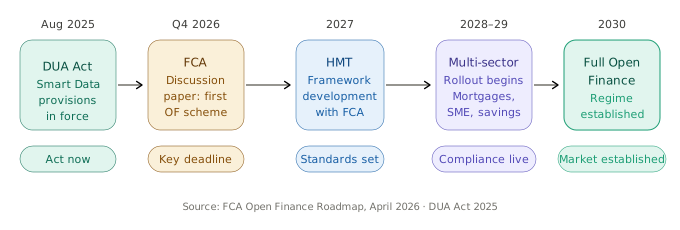
On 14 April 2026, the Financial Conduct Authority published the document that UK financial services data leaders have been anticipating for two years: its formal Open Finance Roadmap to 2030. The reaction in many organisations has followed a familiar pattern: brief internal briefing notes and a quiet consensus that this is "one to watch" rather than "one to act on immediately." That instinct is wrong. The FCA has not published a vague aspiration. It has published a sequenced delivery programme, with a discussion paper on the first formal Open Finance scheme due in Q4 2026 and a long-term regulatory framework to be developed with HM Treasury through 2027. For many firms, the gap between "we will deal with this when the regulations arrive" and "we are already behind" is measured in months.
The structural conditions underpinning Open Finance are also categorically different from what preceded Open Banking. Part 1 of the Data (Use and Access) Act 2025, the Smart Data provisions, came into force in August 2025. The legislative authority for mandatory data-sharing frameworks across financial services is not approaching: it already exists in statute. What the FCA roadmap does is place a commercial and operational timeline on top of that legal foundation. Organisations without a systematic view of their data assets, API architecture, and governance posture are already behind the curve.
Key Takeaways
- The FCA's Open Finance Roadmap, published 14 April 2026, sets a sequenced delivery path to 2030, with the first formal Open Finance scheme discussion paper due in Q4 2026, six months from now.
- Smart Data provisions under the Data (Use and Access) Act 2025 are already in force, providing the legislative authority for mandatory data-sharing frameworks across UK financial services.
- The global API economy reached $16.29 billion in 2026 and is growing at 34% CAGR; firms treating APIs as internal plumbing rather than commercial products are forfeiting significant revenue and competitive positioning.
- The FCA's priority use cases, SME credit and consumer mortgage access, will favour firms with clean, well-governed, API-accessible data from the outset; readiness is a competitive differentiator before it becomes a compliance requirement.
- Firms engaged in the FCA's Smart Data Accelerator and PRISM Taskforce are actively shaping the standards that will govern Open Finance; those not engaged will implement standards set by others.
- DataEquity's API Curator is designed for precisely this transition: helping regulated financial services organisations structure, govern, and commercialise their APIs as data products before formal scheme obligations arrive.
The FCA Has Drawn the Map: What the Open Finance Roadmap Commits To
The FCA's roadmap is an operational programme, not a policy statement, and its architecture matters. The regulator has identified specific priority use cases where data sharing can deliver measurable consumer outcomes most quickly. SME lending and consumer mortgage access are the first two domains, targeting areas where structured data sharing can materially reduce friction in credit markets and improve affordability assessments.
Two TechSprints ran between November 2025 and February 2026, one on mortgages and one on SME finance, in partnership with Raidiam, allowing participating firms to simulate data sharing through the FCA's Smart Data Accelerator. The PRISM (Prioritisation and Real-world Insights Selection Matrix) Taskforce will continue this work through 2026, determining which use cases are ready for formalisation into formal scheme designs.
The Q4 2026 discussion paper on the first formal Open Finance scheme is the near-term milestone that should be driving internal planning today. A discussion paper is not simply a statement of intent; it is an active consultation that will draw heavily on evidence from firms already engaged in the preparatory programme. Organisations with structured, well-governed data estates and mature API capabilities will contribute to and influence the resulting standards. Firms without that foundation will implement standards shaped by those that have it.
Beyond Open Banking: A Scope Change That Is an Order of Magnitude Larger
Open Banking applied to a narrow, precisely defined dataset at nine large institutions. Open Finance extends across investments, savings, pensions, insurance, mortgages, and business credit, applying to a far wider range of regulated firms. The scale of data that must be structured, governed, and accessible via regulated APIs is not incrementally larger than Open Banking. It is categorically larger, and that difference determines how much preparatory work is required and how long it realistically takes.
Why Q4 2026 Is the Effective Deadline for Data Leaders
Regulatory timelines in financial services follow a consistent pathology. A discussion paper is published. Responses are gathered. A consultation paper follows. A policy statement follows that. Rules are finalised. An implementation period is granted. Firms that begin preparing only once rules are confirmed consistently arrive underprepared. The organisations that navigate Open Finance well will be those that treat the Q4 2026 discussion paper as their operational starting signal, not the formal rule publication eighteen months or more later.
Data readiness is not a sprint that can be compressed into a short implementation window. Documenting what data an organisation holds, how it is structured, what its quality characteristics are, and whether it can be exposed via governed APIs with appropriate consent frameworks and data lineage tracking: this is a programme that routinely takes large regulated firms twelve to eighteen months to complete properly. An organisation beginning this work in early 2027 will be building its readiness position under conditions already shaped by competitors who moved earlier.
There is also a competitive dimension that sits alongside the regulatory one. The FCA has been explicit that Open Finance is intended to improve outcomes for consumers and SMEs through better access to credit and financial services. Firms with well-governed, API-accessible data will participate in Open Finance ecosystems as recipients of third-party data, not merely as contributors. Those without the data governance foundation to support reciprocal exchange will forfeit the inbound commercial benefits that Open Finance is designed to create.
The API Readiness Gap: From Internal Plumbing to Regulated Data Product
The most significant gap between where most financial services organisations currently sit and where Open Finance requires them to be is in how they conceptualise their APIs. For the majority of UK financial firms, APIs are internal integration mechanisms, tools connecting legacy systems or supporting internal development. Open Finance repositions APIs as regulated data products, subject to governance standards, consent frameworks, version control, documentation requirements, and in many cases formal commercial models.
An internal API can be poorly documented and maintained on a best-efforts basis without significant consequence. A regulated data product must be auditable, formally governed, and capable of handling consent-based access at a customer's request. It must be structured to generate verifiable value through monetised third-party access, reciprocal data-sharing arrangements, or the operational benefit of powering external services that reduce the firm's cost base.
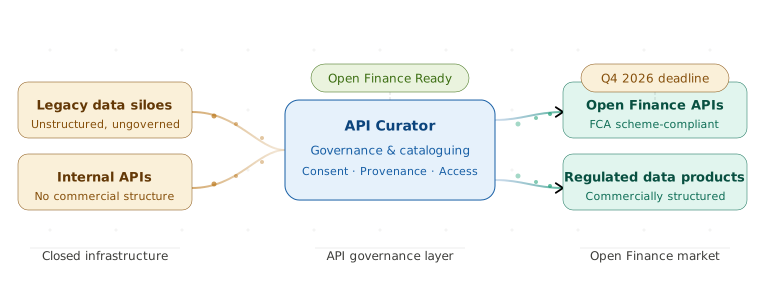
The global API economy reached $16.29 billion in 2026, growing at 34% CAGR. Financial services is one of the highest-value domains within it. UK firms already productising their data APIs, establishing clear ownership, governance frameworks, and commercial models, are not simply preparing for compliance. They are building positions in a market where access to structured, governed financial data commands a premium. DataEquity's API Curator provides the governance and commercial structure layer that transforms a portfolio of internal endpoints into a catalogue of market-ready data products, with the documentation, provenance tracking, and access control framework that Open Finance schemes will require.
Smart Data and the DUA Act: The Legislative Foundation Is Already Live
The Smart Data provisions in Part 1 of the Data (Use and Access) Act 2025 came into force on 19 August 2025. The legislative authority for the Government and regulators to create and mandate Smart Data schemes, requiring designated data holders to share specific categories of data with authorised third parties at a customer's request, is already present in statute.
The ICO is expected to publish guidance on storage and access technologies in Spring 2026, following a public consultation in Autumn 2025. This guidance will materially affect how organisations must structure their data access controls and technical interfaces. Firms that have already mapped their data architecture against the DUA Act's requirements will absorb this guidance efficiently. Those starting from a blank sheet face a more disruptive and costly adjustment at a time when regulatory attention is intensifying.
The broader significance of the DUA Act extends beyond financial services. The Smart Data framework is designed as a cross-sectoral architecture, with schemes planned for energy, telecommunications, and healthcare. Organisations that build data governance and API productisation infrastructure in response to the financial services programme are not solving a one-time compliance problem. They are building the foundation for every subsequent sector-specific Smart Data scheme, a consideration that carries particular weight for regulated groups operating across multiple industries.
Frequently Asked Questions
Q1: What is Open Finance and how does it differ from Open Banking?
Open Banking required the nine largest UK banks to share current account and payments data via regulated APIs at the request of account holders. It operated on a narrow, well-defined dataset applied to a small number of institutions. Open Finance extends this principle across investments, pensions, savings, insurance, mortgages, and business credit, applying to a far wider range of regulated firms. The FCA's April 2026 roadmap sequences this expansion through to 2030, with SME lending and mortgage access as the first priority domains and formal scheme design beginning with a Q4 2026 discussion paper.
Q2: Is Open Finance compliance already legally mandatory?
Not yet in the sense of carrying formal enforcement consequences. The first formal Open Finance scheme discussion paper is due Q4 2026, with a regulatory framework developed through 2027. However, the Smart Data provisions of the DUA Act 2025 are already in force, providing the legislative authority for mandatory obligations. The practical question for CDOs is not whether obligations will arrive, but whether their organisations will be positioned to meet them and to shape the standards during the consultation that precedes them.
Q3: What are the risks of not being data-ready when formal Open Finance obligations are confirmed?
Risks operate across several dimensions. Regulatory risk includes potential FCA and ICO enforcement exposure for failing to meet data-sharing obligations. Operational risk includes the cost and disruption of reactive remediation under time pressure, the most expensive way to address structural data quality and governance gaps. Commercial risk may prove the most significant: the inability to participate as a recipient of third-party Open Finance data forfeits benefits that well-prepared competitors will extract from day one.
Q4: Where should a CDO start today, practically?
The most valuable immediate step is a structured data inventory and quality assessment: establishing an accurate, documented picture of what data the organisation holds, at what granularity, in which systems, and under what governance framework. Alongside this, an API maturity assessment is essential: cataloguing existing APIs, how they are governed, and the gap relative to regulated data product standards. Together, these exercises typically take eight to sixteen weeks for a large regulated firm and are essential prerequisites for meaningful engagement with the Q4 2026 consultation.
Q5: How does the EU Data Act intersect with the FCA roadmap for firms operating across both jurisdictions?
UK firms with EU operations face a dual regulatory landscape. The EU Data Act, directly applicable in EU jurisdictions, includes data-sharing obligations with structural similarities to the UK's Smart Data framework, though with different sectoral scope and technical requirements. Building data governance and API infrastructure designed from the outset to accommodate both regimes is materially more efficient than developing parallel systems. For multi-jurisdictional regulated groups, data readiness infrastructure is a pan-European strategic priority, not a UK-specific compliance exercise.
Q6: What is DataEquity's API Curator and how does it support Open Finance readiness?
API Curator is DataEquity's platform for helping regulated organisations transform their existing APIs from internal integration tools into governed, commercially-structured data products. It provides a framework for cataloguing, documenting, and governing an organisation's API estate, establishing clear ownership, version control, access management, and commercial structures for each product. In the context of Open Finance, it enables firms to take stock of their API landscape, identify candidates for productisation under Open Finance standards, and build the governance layer that regulated data sharing will require. It sits alongside DataVault, DataEquity's on-premise data discovery and valuation platform, and the DE Marketplace, which connects organisations with pre-qualified buyers for their structured data products, creating a complete pipeline from data assessment through to commercial monetisation.
The FCA has done the industry a genuine service by publishing a sequenced, milestone-specific roadmap rather than another aspirational vision document. For data leaders in UK financial services, the roadmap provides something rare: a clear set of milestones against which internal preparation can be benchmarked, resourced, and accelerated. The Q4 2026 discussion paper is the effective starting gun. The organisations that are ready for it will shape Open Finance. Those that are not will implement what others designed.