
Data Monetization: The Strategic Guide to Valuing and Commercialising Data Assets
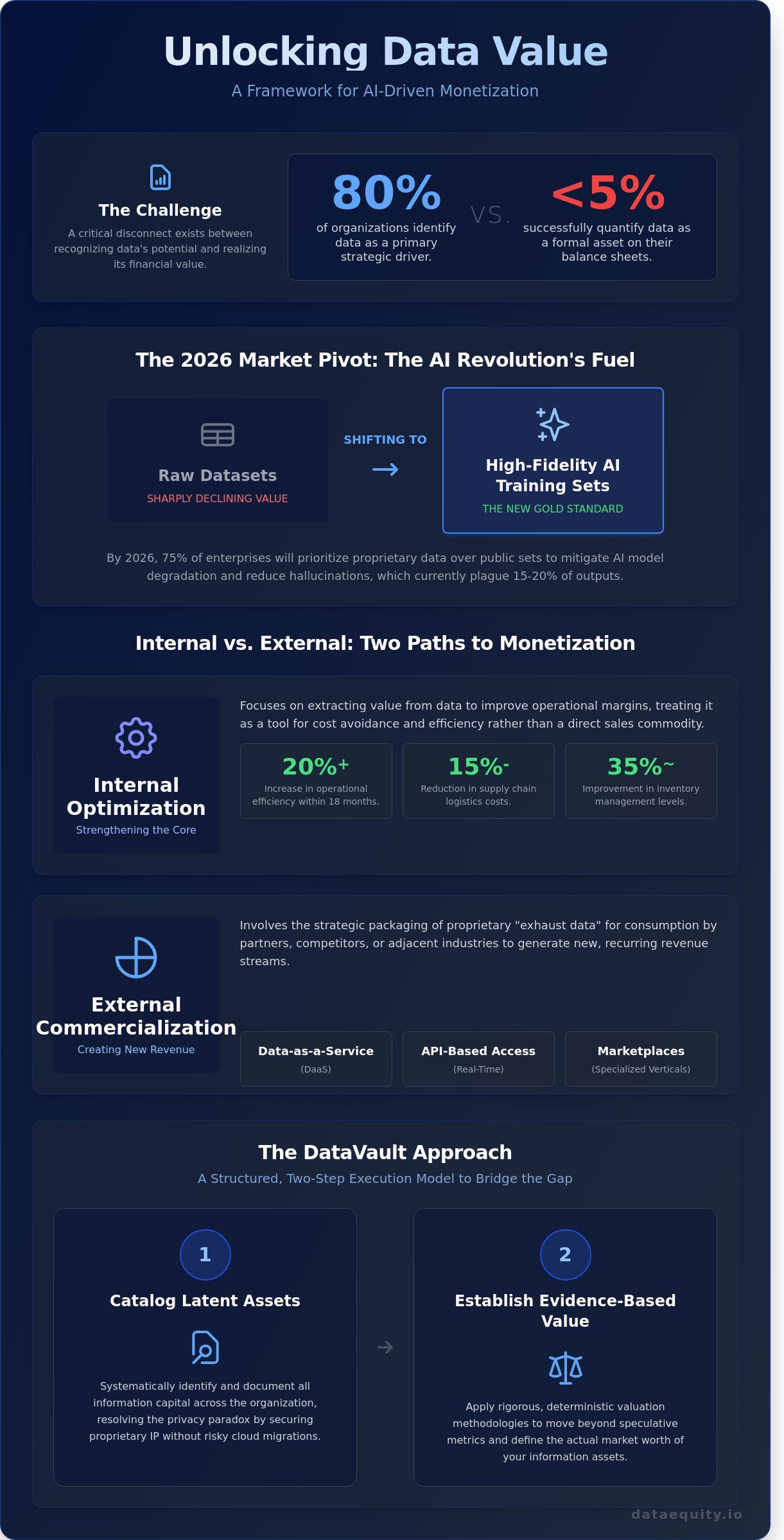
A recent 2023 study by Gartner reveals that while 80% of organizations identify data as a primary strategic driver, fewer than 5% of these firms successfully quantify it as a formal asset on their balance sheets. You've likely recognized that your infrastructure is housing immense latent value, yet the methodology for effective data monetization remains elusive. The fear of regulatory penalties under GDPR or CCPA, combined with the risk of intellectual property leaks during the discovery phase, often stalls even the most ambitious commercialisation efforts.
This guide demonstrates how to bridge the gap between technical storage and financial performance through structured, AI-driven valuation models. We'll outline a rigorous path to move beyond guesswork and provide a deterministic view of your information capital. We'll also examine the architectural requirements for a secure path to market, enabling you to generate new, recurring revenue streams from existing metadata. By the end of this analysis, you'll possess a clear framework for transforming raw data into a validated, commercial-grade financial asset.
Key Takeaways
- Understand the critical transition from selling raw datasets to providing high-fidelity AI training sets within the modern digital economy.
- Distinguish between internal operational optimization and external commercialization to identify the most effective path for asset growth.
- Master deterministic valuation methodologies to bridge the gap between speculative metrics and the actual market value during the data monetization process.
- Resolve the privacy paradox by securing proprietary intellectual property through frameworks that eliminate the need for risky centralized cloud migrations.
- Apply a structured, two-step execution model to catalog latent assets and establish evidence-based valuation through the DataVault approach.
What is Data Monetization in the AI-Driven Economy?
Data monetization represents the methodical process of converting information assets into measurable economic value. It's no longer a simple exchange of raw spreadsheets for capital. By 2026, the market will pivot decisively from "raw data sales" to the provision of "high-fidelity AI training sets." This evolution requires a shift in how executives view their digital inventory.
The value of information now depends on its utility for machine learning. Metadata has emerged as the new "gold" for enterprise LLM fine-tuning because it provides the necessary context that raw text lacks. Without high-quality metadata, a model cannot distinguish between a casual customer inquiry and a high-intent sales lead. Precision in data labeling and structural integrity determines the final ROI. The market doesn't wait for laggards. Organizations that fail to audit their data assets by 2025 will find their proprietary information obsolete by the time 2026 industry standards take hold.
The 2026 Data Landscape: Fueling the AI Revolution
General web-scraped data is experiencing a sharp decline in value. Gartner predicts that by 2026, 75% of enterprises will prioritize proprietary data over public sets to mitigate the risk of model degradation. High-quality, verified datasets are essential for reducing AI hallucinations, which currently plague 15% to 20% of generative AI outputs.
Direct vs. Indirect Monetization
Direct monetization involves Data-as-a-Service (DaaS), API-based commercialization, and participation in specialized marketplaces. This path offers immediate revenue but requires robust security protocols. Indirect monetization focuses on internal gains: process automation, predictive maintenance, and customer churn reduction. Research from IDC indicates that companies using indirect data monetization strategies see a 20% increase in operational efficiency within 18 months. Determining the right path depends on your industry's regulatory constraints and the uniqueness of your data silos. Most successful firms balance both; they use internal optimization to fund external marketplace ventures.
Internal vs. External Data Monetization Strategies
Choosing between internal and external data monetization isn't a binary decision; it's a strategic alignment of assets with market demand. Organizations must first audit their data maturity to determine if their telemetry is better suited for streamlining their own P&L or for creating a new line of credit on the balance sheet. Precision in this phase prevents the misallocation of engineering resources toward products the market doesn't yet require.
Internal Optimization: The Foundation of Data Value
Internal monetization focuses on extracting value from data to improve operational margins. This approach treats data as a tool for cost avoidance and efficiency rather than a direct sales commodity. A 2023 McKinsey report highlighted that organizations utilizing predictive analytics in supply chain management achieved a 15% reduction in logistics costs and a 35% improvement in inventory levels. By applying machine learning to internal "exhaust data," firms identify bottlenecks that human intuition often misses.
Success here requires a "data-first" culture where every departmental output is structured for machine readability. This methodological discipline ensures that data quality remains high, creating a clean repository that can eventually be pivoted toward external markets. If the data isn't clean enough to run your own warehouse, it's certainly not valuable enough for a third-party buyer to purchase.
External Commercialisation: Creating New Revenue Streams
External monetization involves the strategic packaging of proprietary insights for consumption by partners, competitors, or adjacent industries. This often takes the form of "exhaust data," which are the digital footprints left behind by primary business activities. For instance, a telecommunications provider might aggregate anonymous location data to help urban planners or retailers understand foot traffic patterns.
According to 2024 industry benchmarks, companies that transition from selling raw datasets to providing API-based insights see a 22% increase in customer lifetime value. This shift requires a robust legal framework to manage intellectual property and privacy compliance, ensuring that the commercialization doesn't compromise the core business.
The hybrid approach represents the highest level of maturity, where a company builds a digital ecosystem around its data. This creates a feedback loop where external usage data further optimizes internal operations. Organizations that fail to make this distinction often find themselves with high technical debt and no clear path to profitability.
The Valuation Gap: How Much is Your Data Actually Worth?
Traditional accounting models frequently treat data as a sunk cost or an operational expense. This "cost-to-collect" approach is fundamentally flawed because it measures the effort of acquisition rather than the utility of the output. Market participants often struggle to monetize data effectively because they rely on probabilistic guesswork instead of empirical demand metrics. This creates a valuation gap that prevents data from being recognized as a high-grade asset on the corporate balance sheet.
The value of data is rarely static. It's dictated by specific variables that professional auditors now use to replace intuition with logic:
- Uniqueness: Proprietary datasets that aren't represented in open-source corpuses command the highest premiums.
- Decay Rate: A 15% monthly decay rate in consumer preference data makes it a perishable commodity, whereas geological survey data retains value for decades.
- Completeness: Missing fields in a dataset can reduce its training utility by up to 60%.
- Regulatory Risk: Data without a verifiable consent trail is a liability, not an asset.
In the current AI climate, demand isn't uniform. Training requirements for Large Language Models (LLMs) create 300% value surges for niche datasets. For example, localized dialect recordings or specific industrial failure logs from 2024 are currently seeing unprecedented price spikes because they're essential for fine-tuning specialized AI agents.
Deterministic vs. Probabilistic Valuation
Probabilistic models are dangerous because they fluctuate based on market sentiment and vague comparisons. Deterministic valuation shifts the focus to intrinsic utility, using AI-driven engines to quantify how much a specific dataset improves model accuracy. The DataVault methodology provides a financial-grade assessment of data assets by applying rigorous actuarial principles to digital information. It's the difference between guessing a price and proving a value through measurable evidence.
Factors That Inflate (or Deflate) Data Price
Timeliness is the primary driver of the data monetization premium. Real-time API access often commands a 5x price multiplier compared to batch-delivered historical archives. Compliance also dictates the floor price. A 2024 industry analysis showed that datasets with a "clean" consent trail for GDPR and CCPA fetch 40% higher prices than those with ambiguous origins. Finally, interoperability determines the ease of sale. Data that integrates into existing AI pipelines without extensive cleaning reduces the buyer's overhead, which directly increases the seller's margin.
Overcoming the Privacy and Security Paradox
The primary barrier to data monetization isn't a lack of buyers; it's the rational fear of compromising proprietary intellectual property. According to the 2023 IBM Cost of a Data Breach Report, the average cost of a breach has reached $4.45 million. For a CFO, the potential revenue from an external marketplace often pales in comparison to the catastrophic risk of a leak. Traditional models that require moving raw datasets to a centralized cloud for assessment are fundamentally flawed.
A shift toward metadata-first discovery solves this paradox. Instead of exposing raw records, organizations analyze the statistical shape, schema, and cardinality of their data. This allows for a precise valuation without the content ever leaving its source. It's a move from blind trust to verifiable security protocols that protect the core assets of the business while identifying latent value.
On-Premise Discovery: Assessing Value Without Moving Data
On-premise agents allow for in-place valuation, meaning the analysis logic travels to the data. These agents catalog metadata locally, identifying patterns and commercial potential without exfiltrating sensitive records. This technical architecture reduces the attack surface by approximately 95% during the commercialization lifecycle. By keeping data within a private VPC or behind a local firewall, companies maintain total sovereignty.
Compliance-as-a-Feature
Compliance shouldn't be a manual bottleneck. Modern systems automate PII masking and anonymization with 99.9% accuracy, ensuring that data monetization efforts align with GDPR and the EU AI Act. Manual intervention in data cleaning is responsible for 82% of security incidents, so automation is a security requirement, not a luxury. Evidence-based assessments provide a verifiable audit trail for regulators, turning compliance into a transparent, repeatable feature of the data pipeline.
Implementing a Scalable Data Monetization Framework
Generating recurring revenue from information assets requires a transition from passive storage to active market participation. Organizations often sit on vast reserves of untapped potential; a 2023 report indicated that up to 68% of enterprise data remains unanalyzed. A structured data monetization framework eliminates this waste by applying methodological precision to the asset lifecycle.
- Discovery and cataloguing. We use automated tools to audit legacy systems and cloud environments. This identifies latent assets that possess high commercial relevance but currently lack visibility.
- Evidence-based valuation. Using the DataVault approach, we quantify the economic value of your datasets. We look at scarcity, accuracy, and historical utility to set a price point backed by logic rather than intuition.
- Packaging via secure APIs. Data shouldn't be moved in static, insecure files. We structure assets into robust API endpoints. This ensures security, allows for real-time updates, and provides a professional interface for consumers.
- Marketplace connection. The final stage involves listing these assets in an AI-driven ecosystem. Here, your data is matched with pre-qualified buyers who have already passed rigorous compliance checks.
From Discovery to Commercialisation
AI identifies "hidden gems" in legacy databases by detecting patterns that human auditors miss. These tools can categorize petabytes of information in hours, a task that previously took months. An AI-driven marketplace significantly reduces sales cycles, often shrinking them from a 180-day enterprise negotiation to a 14-day digital transaction.
Frequently Asked Questions
How is data monetization defined in a business context?
Data monetization is the process of converting raw organizational data into quantifiable economic value. Companies achieve this by utilizing internal data to optimize operational efficiency or by selling anonymized datasets to external third parties. According to a 2023 Gartner report, organizations that actively prioritize data monetization are 3 times more likely to outperform their peers in profitability.
What are the main types of data monetization strategies?
Businesses typically choose between direct and indirect strategies to extract value from their information assets. Direct methods involve the sale of raw or processed data through marketplaces, while indirect methods focus on using analytics to reduce churn or improve supply chain efficiency. McKinsey research from 2022 indicates that indirect strategies account for nearly 70% of the total value generated in the enterprise sector.
How do companies value data for AI training?
Valuation is determined by the data's uniqueness, volume, and its specific utility for training large language models or predictive algorithms. Factors such as freshness and labeling accuracy significantly influence the market price. The MIT Initiative on the Digital Economy suggests that proprietary datasets with high longitudinal depth often command a 40% premium over generic public data.
Is data monetization legal under GDPR and CCPA?
The commercial use of information is legally permissible provided that organizations adhere to strict anonymization, consent, and transparency requirements mandated by regulations like the GDPR and CCPA. Compliance hinges on the removal of Personal Identifiable Information so that individuals can't be re-identified within the dataset.
Can I monetize my data without moving it to the cloud?
Yes. Edge computing and federated learning models allow algorithms to train on-premises without moving the raw information. A 2024 industry survey found that 25% of financial institutions prefer these decentralized methods to maintain maximum security.
What is the difference between data commercialisation and data sharing?
Data commercialisation focuses on the exchange of data for direct financial gain, whereas data sharing is often a collaborative effort to improve ecosystem efficiency. Commercialisation treats data as a product with a clear price tag and delivery schedule.
How much revenue can a mid-sized enterprise expect from data monetization?
A mid-sized enterprise with 500 to 2,000 employees can typically generate between 1% and 5% of their annual revenue through strategic data monetization initiatives. According to a 2023 study by BARC, early adopters in the manufacturing and retail sectors saw a median revenue increase of 3.2% within the first 18 months.
What is a DataVault report and why do I need one?
A DataVault report is a technical and financial audit that identifies the commercial potential of your existing datasets. It provides a structured roadmap for implementation by quantifying the volume, quality, and market demand for your information assets. This report is essential because it bridges the gap between raw technical storage and strategic business intelligence.